

A review of the Rat Park experiments
The rat park experiment is now familiar to many people in the addiction community. It is frequently mentioned in books, lectures, and popular TED talks about the nature of addiction and its root causes.
This post takes a closer look at the study and what it does or does not contribute to that understanding.
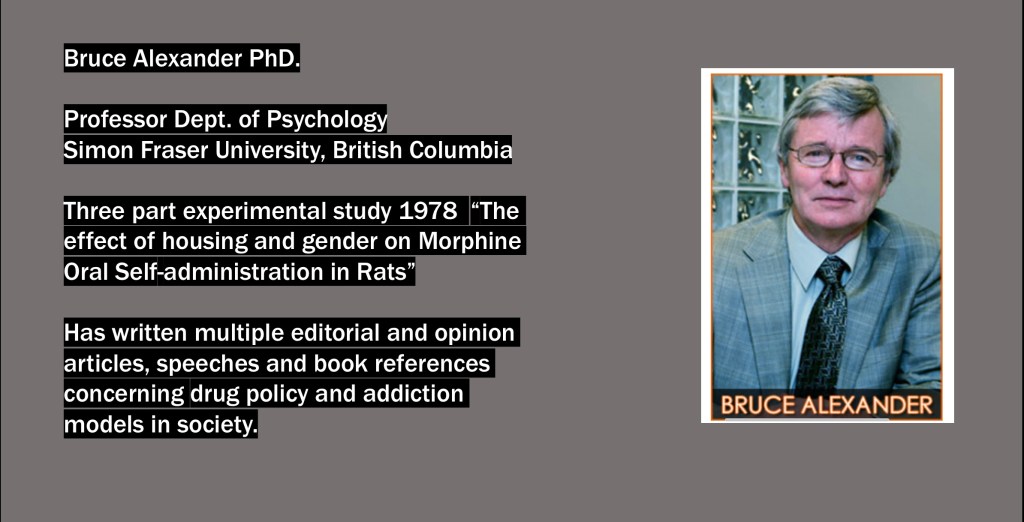
The study was performed by Bruce Alexander a professor of psychology at Simon Fraser University in British Columbia in 1978. At that time there was considerable interest in animal models of addictive behavior. The study sought to measure the impact of social and environmental influences on addictive behavior in a laboratory controlled setting. It generated little interest when first published and only recently has gained more popular notice.
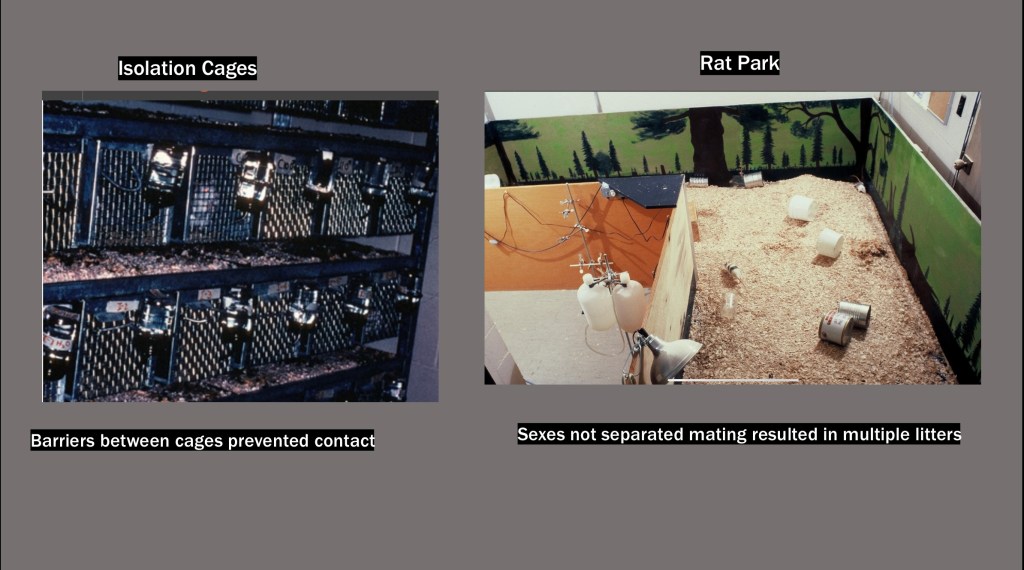
The study was conducted in three parts. In all parts the animals were placed in one of two environments. The rats were separated at weaning. Both groups were given unlimited food and the same light/dark cycle.
The isolated rats were kept in small individual cages with barriers to keep them apart. The cages were 10”x 8” the average adult Wistar rat is about 9” in length.
The investigators created a large area for the communal rats. The Rat Park had a wood shaving floor, tunnels and poles for them to explore, even a painted landscape on the walls. They were not separated by gender. Multiple litters resulted from mating.
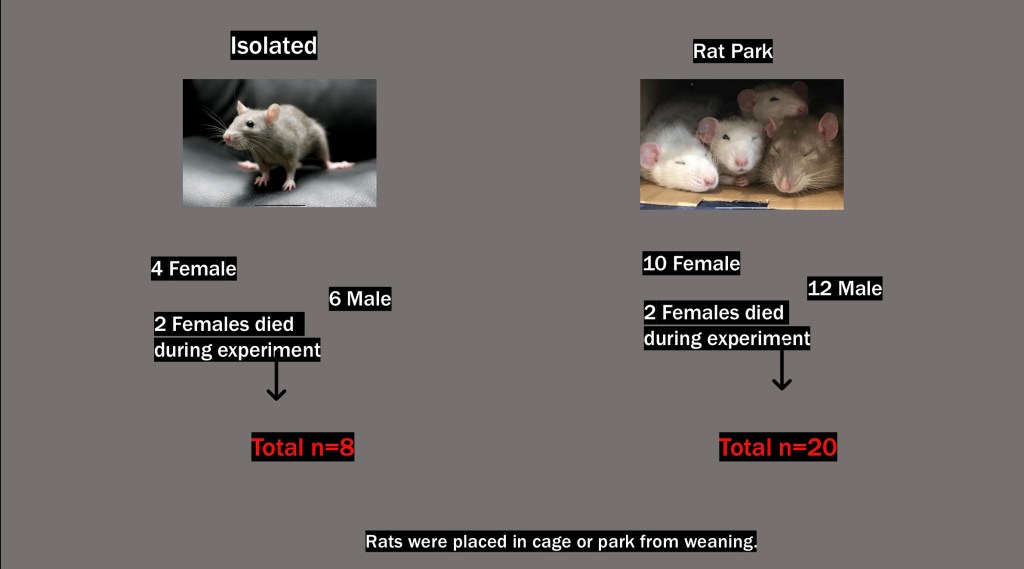
The first study consisted of 4 female and 6 male rats. Two female rats from each group died during the study. 10 female and 12 male rats were in the original Rat Park group.
The reason for different size groups was not explained. The number of rats included in the isolated group was very small for a study like this and low in statistical significance.
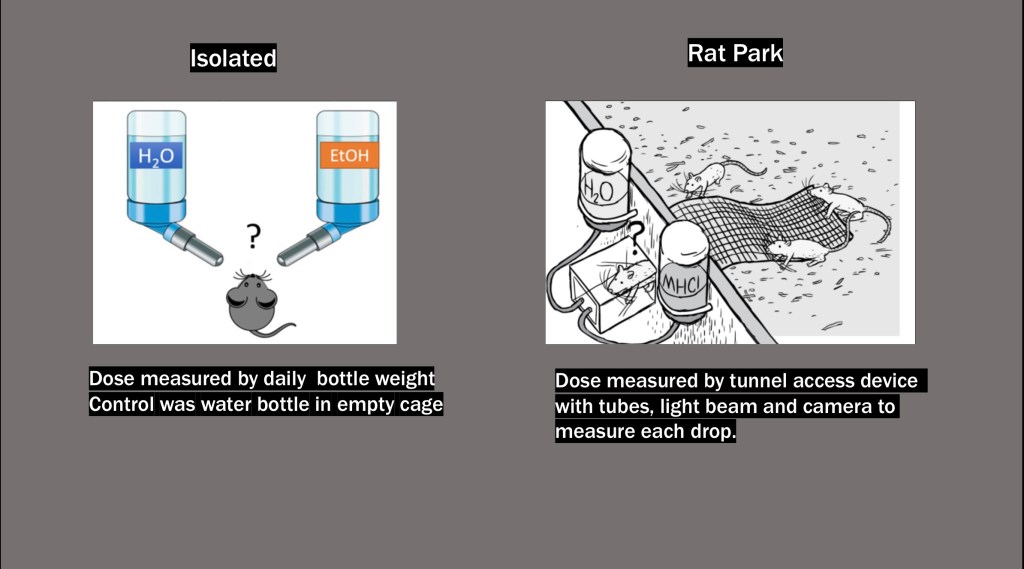
Two different methods for measuring consumption of water or morphine solution was performed for the two groups.
Consumption for the isolated group was a basic two bottle setup. Dose was estimated by weighing the bottle before and after each session.
Measurement in the rat park group was more elaborate. A tunnel was constructed with a video camera and a light beam which activated dispensing of a single drop of solution. Rats were marked for identification.
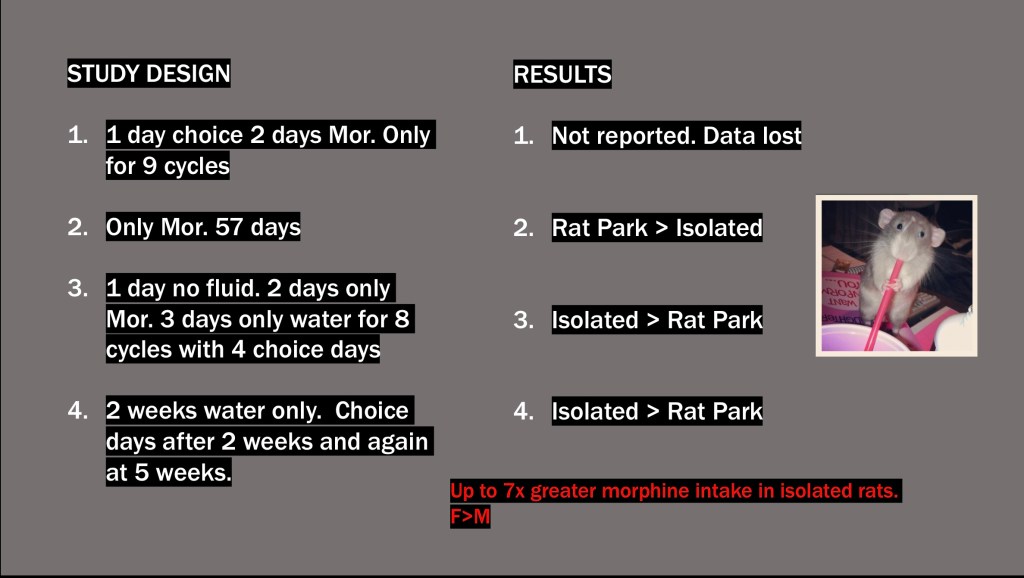
The study design was somewhat complicated with the goal of first habituating both groups to oral morphine and then determining preference differences between the two groups.
The procedure involved 4 stages as described above with morphine only, water only, and choice cycles incorporated into the study design.
Data was lost for the first stage in the rat park group and not included in the results.
The end result was greater morphine intake by the isolated group up to 7x more than the rat park group.
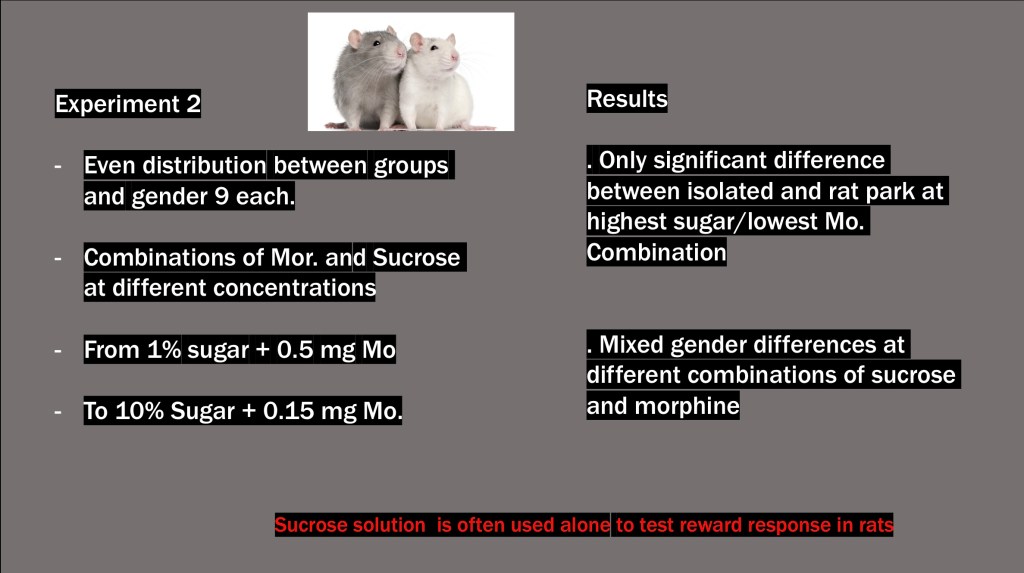
The second part used equal numbers of rats in each subgroup. It looked at variable concentrations of sugar added to the solution along with decreasing concentrations of morphine.
The most significant difference was seen in the solution with the highest concentration of sucrose 10% and the lowest concentration of morphine 0.15 mg. This mixture was preferred by the isolated rats. Results from gender differences were inconclusive.
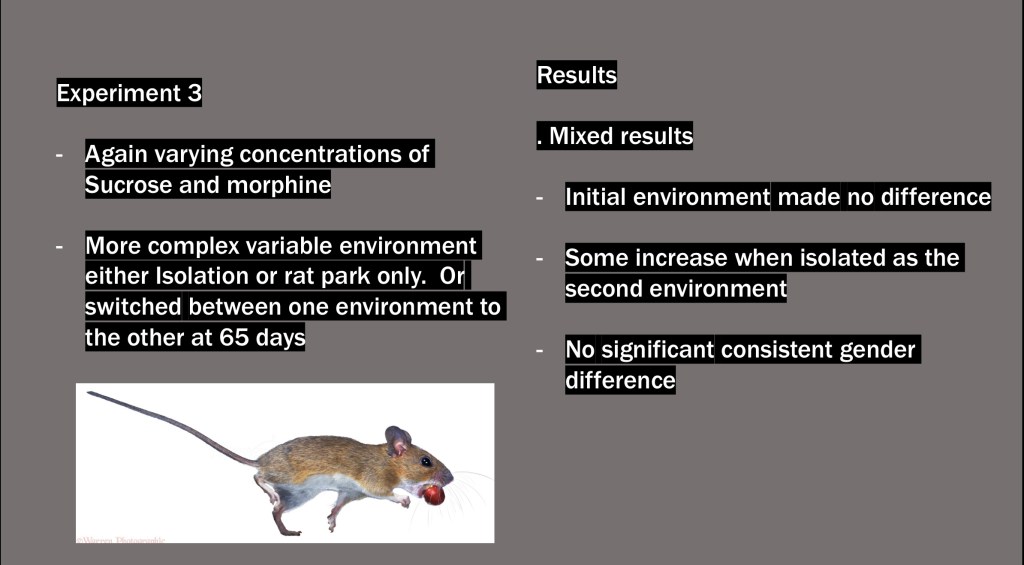
The third stage looked at results when rats started in one group and then were switched to the other. They found no difference related to initial group assignment but a modest increase in rats switched into isolation. Again the low morphine/high sugar solution produced the largest difference.
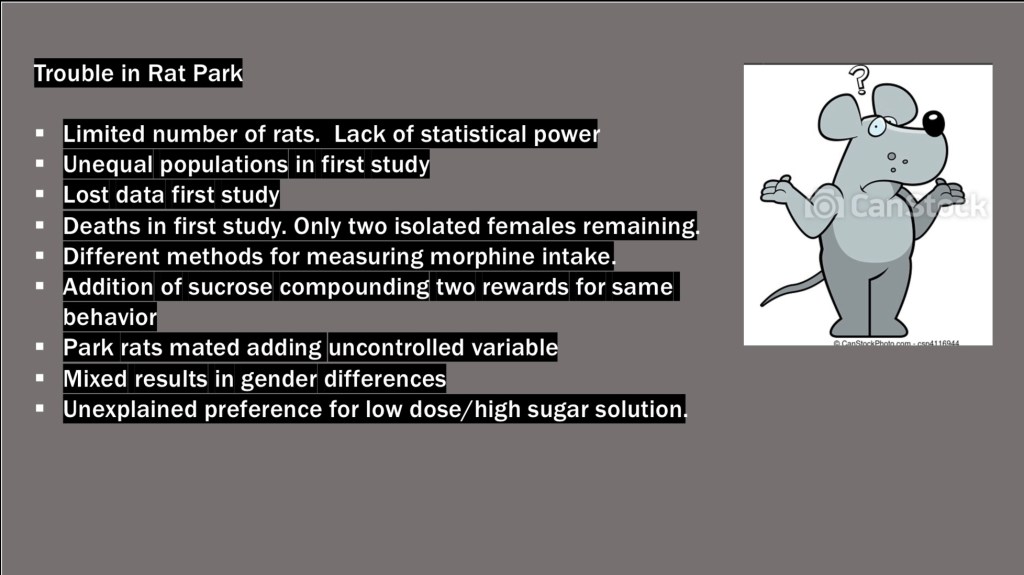
A number of problems with the experiment have been pointed out. These are described above. One of the most significant potential limitations is possible systematic error due to the two different measurement methods of the primary outcome, amount of morphine consumed, between the two groups. The addition of sugar to the solution, a strong incentive for rats, also introduces a confounding variable.
Mating and reproduction only possible in the rat park group is another issue. Rats have a limited set of behaviors, mating is one of them.
In any scientific study two elements are key to determine validity, reproducibility and supportive evidence from similar studies.
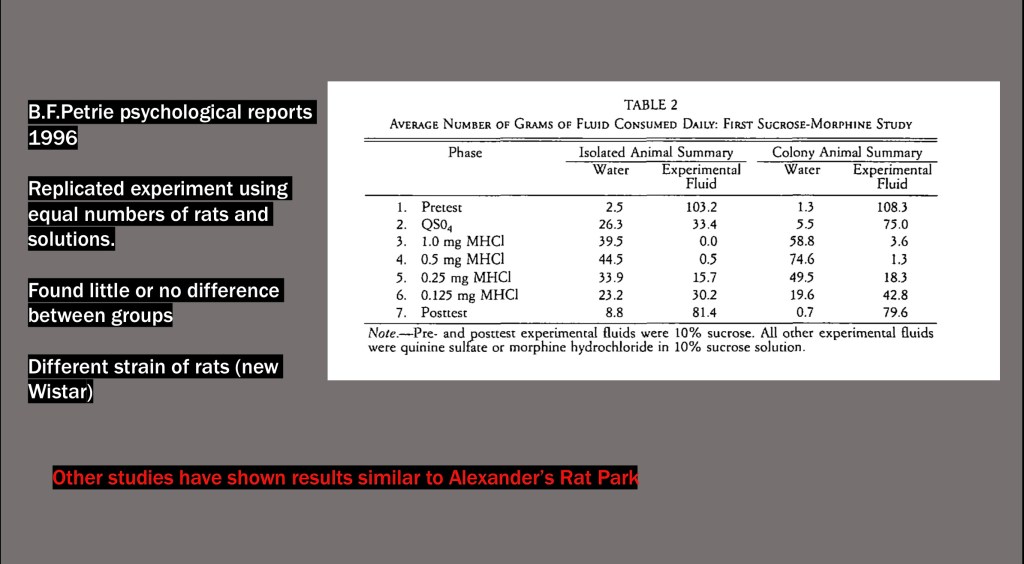
In 1993 B.F. Petrie attempted to reproduce Alexander’s original experiment. He then repeated the study correcting for the discrepancy introduced by differing measurement techniques. Although he found small differences between groups he was not able to reproduce the significant results found in the original rat park experiment. One possible explanation is that he could not find the same lineage of rats used in the original study.
Results from other similar animal studies are mixed with some supporting Alexander’s findings. Previous work in animals had already established these findings. Irrespective of that at this time it is basically a moot point.
Many large scale studies of environmental and genetic components of addiction in humans are now available. Environment and social influences are well known factors and not disputed within the mainstream scientific and clinical community.
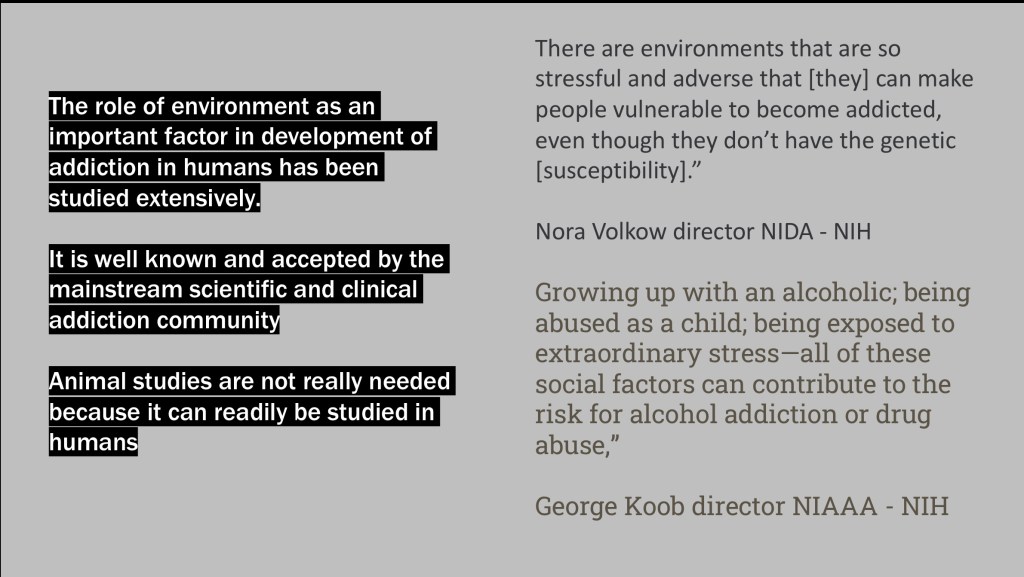
It is difficult to imagine anyone more establishment in the neuroscience of addiction than those two individuals.
Why then this sudden interest in rat park? Why make sweeping conclusions about the complex, incompletely understood interplay of forces and circumstances at work in human addiction based on a flawed obscure experiment from the past?
Rat Park is a good story and what is says and does not say is easily over simplified. It can be told as if it holds some sort of hidden key. There is something to be learned from rat park but it is far from a revelation. It tells us something we already know.
More discussion about strengths and limitations of animal studies here.
Thank you for your consideration in reviewing this post. Feedback and comments are welcome.
For educational and information purposes only. No commercial or institutional interests. Images and data obtained from sources freely available on the World Wide Web. This post should not be considered medical or professional advice.
REFERENCES
Rat Park: How a rat paradise changed the narrative of addiction
Suzanne H. Gage1 & Harry R. Sumnall2
https://livrepository.liverpool.ac.uk/3028403/1/Rat-Park-acceptedmanuscript.docx
…………………………………
Effect of early and later colony housing on oral ingestion of morphine in rats
B K Alexander, B L Beyerstein, P F Hadaway, R B Coambs
Pharmacol Biochem Behav
. 1981 Oct;15(4):571-6.
https://pubmed.ncbi.nlm.nih.gov/7291261/
………………………………….
The Neuroscience of Addiction
Nature Neuroscience
Nora Volkow MD
………………………………..
Speeches and articles by Bruce Alexander
………………………………..
Addict Behav. 2020 March ; 102: 106128. doi:10.1016/j.addbeh.2019.106128.
The epidemiology of alcohol use disorders cross-nationally: Findings from the World Mental Health Surveys
Meyer D. Glantz, Chrianna Bharat, Louisa Degenhardt, Nancy A. Sampson, Kate M. Scott
…………………………………..
Childhood Abuse, Neglect, and Household Dysfunction and the Risk of Illicit Drug Use: The Adverse Childhood Experiences Study
Shanta R. Dube, Vincent J. Felitti, Maxia Dong, Daniel P. Chapman, Wayne H. Giles and Robert F. Anda
Pediatrics 2003;111;564 DOI: 10.1542/peds.111.3.564
…………………………………………
Epidemiology of DSM-5 Drug Use Disorder
Results From the National Epidemiologic Survey
on Alcohol and Related Conditions–III
Bridget F. Grant, PhD, PhD; Tulshi D. Saha, PhD; W. June Ruan, MA; Risë B. Goldstein, PhD, MPH; S. Patricia Chou, PhD; Jeesun Jung, PhD;
JAMA Psychiatry. 2016;73(1):39-47. doi:10.1001/jamapsychiatry.2015.2132 Published online November 18, 2015.
……………………………………………………
The Likely Cause of Addiction Has Been Discovered, and It Is Not What You Think
Posted: 01/20/2015 3:20 pm EST
Johann Hari
Huffington Post
…………………………………….
Rat Park told in comic book form
Stuart McMillen

 Sober Synthesis
Leave a comment