

Mindfulness Daily with Tara/Jack – Mindful Basics https://courses.tarabrach.com/courses/mindfulness-daily
Mindfulness of breathing continues to serve as a home base for presence.
Every breath is a wave, an arc of movement.
Widen the experience of mindfulness by exploring the realm of sensations in the body in a direct, non-judgmental way.
Every experience, whether it’s love or hurt, anger, thinking, or addictive behavior;each and every experience is fueled by physical sensations.
We’re conditioned to pull away from unpleasant sensations and try to hold on to pleasant ones. This means we’re continually reacting with grasping or pushing away.
As we learn to remain present with sensations, we not only free ourselves from old patterns of reactivity. We also receive the gifts of an embodied life.
Our body lives in the present moment. When we’re in touch with our body, we’re here available for life.
D.H. Lawrence: “… bodily the human race is dying. It’s like a great uprooted tree with its roots in the air. We must plant ourselves again in the universe. As we mindfully experience the actual sensations in our body, we’re planting ourselves in the universe.”
When we’re out of touch with a more full felt sense of our body, there are several consequences:
- We’re unable to tune into the intelligence in our body that actually lets us know how to take good care of ourselves. We can’t listen to the messages that are essential for our well-being.
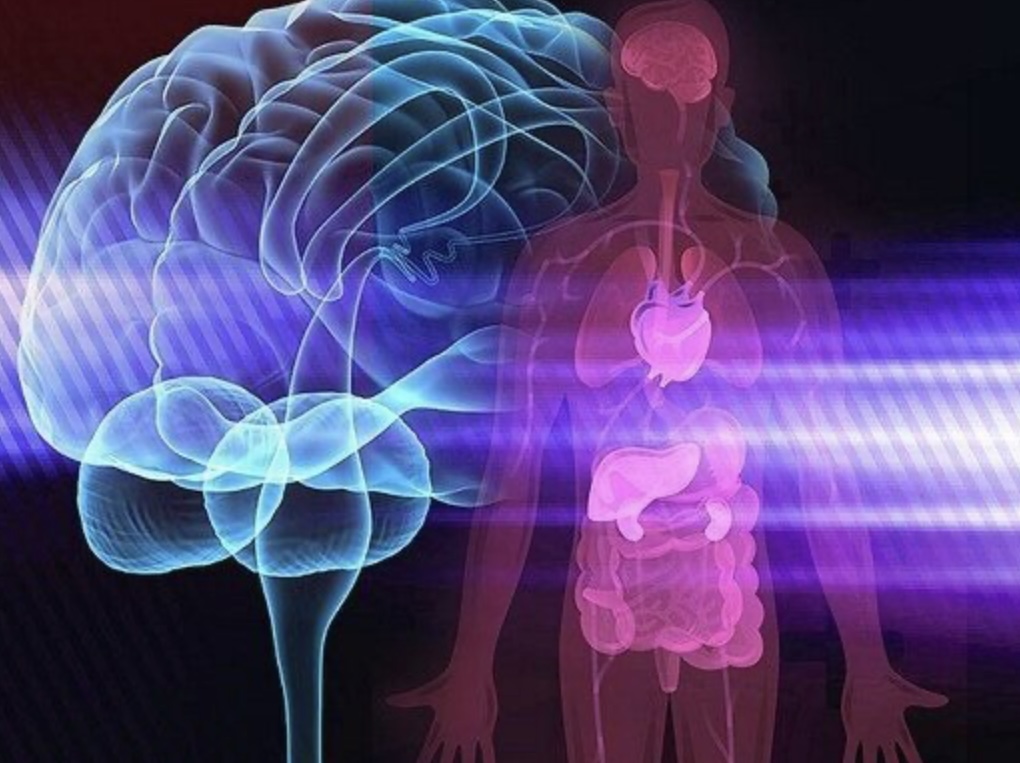
Neuroscience: the brain is connected to huge networks of neurons in the heart and the gut. We don’t think only with our head.
2. Disconnection from our body also limits our ability to sense and comprehend what’s going on in others.
“Our autonomic nervous system is tethered (unconsciously connected) to the autonomic nervous system of others.
Our attachment relationships are essential for emotional regulation.
Attachment is interactive regulation.
Attachment is not psychological, it’s neurobiological
How to develop a more secure attachment?
Understand neuroception (beneath the level of conscious awareness)
Depending on how our nervous system ‘interprets’ a situation determines whether we numb/disconnect, dysregulate/distrust, or connect.” Our Garden, 6/27/25
Mirror neurons that enable us to be attuned to others are only activated if we have a degree of conscious connection with our own sensations and emotions.
So, mindfulness of our body is essential in being empathically connected with others.
When we’re disconnected from our bodies, we don’t feel a visceral sense of belonging to the natural world, to the elements, to the land, to other creatures.
Pulling away from the body means that we’re pulling away from the domain in which we feel love, joy, empathy, creativity, intuition, empowerment. All the experiences that are most central to living a full life.
“The church says the body is the sin. Science says the body is a machine. Advertising says the body is a business. The body says I am a fiesta.”
Eduardo Galeano
Research: brains of advanced meditators on MRI – the part of the brain correlating with perceiving a boundary between self and others decreased substantially.
A sense of unification or connection to the whole.
Breath is an anchor for remaining present with your experience
Being aware of the sensations throughout the body can also serve as an anchor, a home base for connecting with what’s actually happening in the moment.
Naming body sensations is powerful tool for strengthening this awareness of body sensations .
Mindfulness when Pain and Physical Discomfort arises:
Encountering pain or physical discomfort with body scans?
Pain is a call for attention, a survival signal.
Our attention fixates on the pain, and it flavors everything.
While we can’t avoid unpleasant sensations, we can avoid the resistance that leads to pain dominating our awareness.
A resistance to pain brings additional suffering.
MBSR developed for those individuals with chronic pain/chronic conditions.
Subjective ratings of pain are reduced in mindfulness practitioners.
But, mindfulness is not always the wisest or even a possible response to pain. Sometimes, it’s more skillful and compassionate to redirect your attention or to do other things that bring more ease and comfort to your body and mind,
Research, UCLA: MRI scans – the activity of mental noting activates the prefrontal cortex, the site associated with executive functioning. It also reduces activity in the limbic system, which deals with emotions.
Implication is that if you’re having intense unpleasant sensations, naming them correlates with a reduction of reactivity to the experience.
A helpful way to begin awakening mindfulness is by asking the following questions:
What is happening inside me right now?
Can I be with this?
Mindfulness of Feelings and Human Emotions
The emotions we regularly experience, whether depression or confidence, anxiety or trust, directly determine how we respond to our life.
Emotions affect our approach to decision making, abiity to learn, management at work, how well a person heals.
Mindfulness radically shifts and clarifies our relationship with our emotions.
Research: mindfulness training increases our access to balance, resilience, and accurate perception, even in the midst of strong emotions like fear and shame.
Neuropsychology: expanding our window of tolerance.
We cultivate an increased capacity to tolerate stress, to acknowledge what’s going on inside us, and then choose a wise response. In a most profound way, this deepens your self-confidence because you know that you can handle what’s around the corner
 Sober Synthesis
Leave a comment