
Role of Endogenous Opioid System in Musical Rewards

Music is known to have existed in human culture as far back as the origins of language. It is one of the few human activities known to be a cultural universal. Music involves primary functions such as reward, emotions, and movement. It also involves higher order cognitive and integrative learning, aesthetics, social functions, and mathematical knowledge.
The therapeutic benefits of music are well documented. An excellent post can be found on this website here. There have been studies exploring the neuroscience of how the brain processes and responds to musical stimuli. This post is a brief summary of a recent study published in the European Journal of Nuclear Medicine and Molecular Imaging dated April 2025. The study from a research group in Finland sought to further expand knowledge concerning how the brain processes musical hedonic pleasure and reward specifically looking at the role of the endogenous opioid system.
Because these same pathways are central to addiction and music therapy has proven benefit in recovery from SUD it is of interest to the recovery community.

Study subjects included three groups of between 15 – 18 mean age 26 years old, healthy females with no history of neurologic disease. The subjects were each asked to pick a 90 minute song list of music they enjoyed for the test.
Two neuroimaging modalities were employed. Functional MRI (fMRI) and Positron Emission Tomography (PET). These modalities are described in more detail in a previous post. A brief description of these follows. Because these are non invasive techniques allowing for in vivo anatomical, functional, and molecular imaging under controlled conditions they are invaluable in neuroscience.

fMRI employs an MRI sequence to measure transient changes in regional blood flow to specific areas of the brain. This is Blood Oxygen Level Dependent Sequence (BOLD). When a tissue segment requires more oxygen blood flowing through it undergoes a slight magnetic change. Thus it is an indirect measure of function.
Positron Emission Tomography (PET) involves injection of a molecule of interest to which a radioactive isotope is attached, The resulting gamma rays are detected and an image is compiled corresponding to where in the tissue the molecule is biologically active. In this case a tiny amount of Carfentanyl a potent opioid binding to mu opioid receptors was used. “Hot” activity corresponds to μ opioid receptors in the brain.

As a baseline subjects were asked to rate subjective pleasure while listening to music. A two tone sound (A2 and A#6) was played separately as a control. The left graph shows ratings during PET and the right during fMRI.

11C Carfentanyl PET showing areas of increased μ receptor binding while listening to pleasurable music compared to baseline. These included the orbitofrontal cortex, ventral striatum, amygdala, thalamus, and temporal pole.
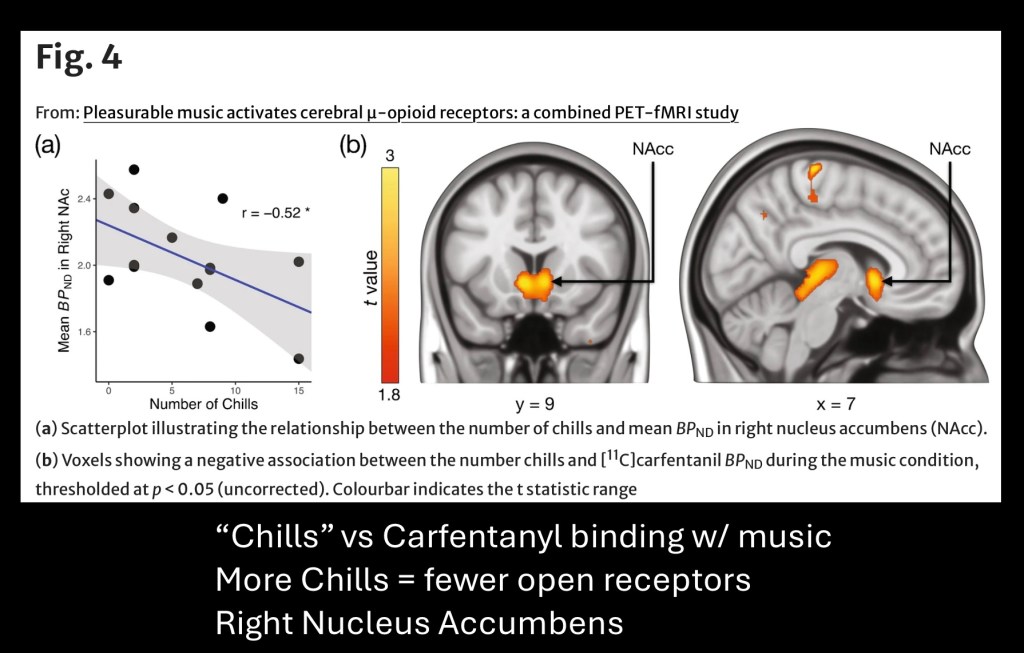
This portion of the study focused on mu receptor binding during episodes of “chills” signifying intense pleasure. The area of interest chosen was the nucleus accumbens, a center known to be essential in reward processing. The graph on the left demonstrates an inverse relationship between chills and mu receptor binding. More chills resulted in fewer open receptors
This is thought to correlate with increased endorphin release to the nucleus accumbens resulting in fewer open receptors available to the isotope.
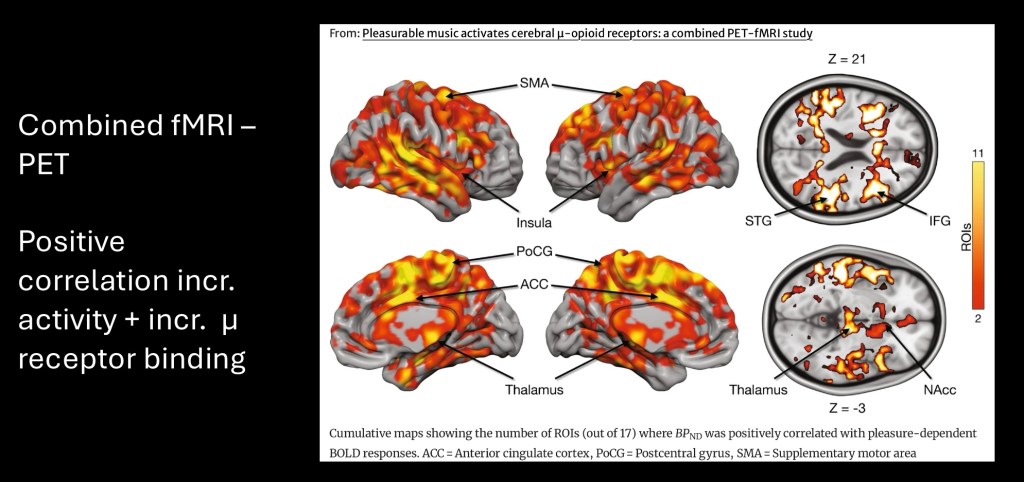
Fusion PET and fMRI analysis. Areas with correlating increased fMRI activity and increased mu receptor binding are shown. These include the thalamus, anterior and posterior cingulate cortex, insula, and supplementary motor area.
This study demonstrates that the endogenous opioid system is involved in complex processing of hedonic reward from music. This involves both essential and non essential rewards, cultural and social cues, and qualitative evaluation.
Understanding of these neural mechanisms has implications for addictions, mood disorders, and motivational regulation which share common pathways. These findings strengthen the case for incorporation of music in therapeutic settings such as this.
……………………………………………………..
For information and educational purposes only. This post should not be considered medical or professional advice. Images and data obtained from sources freely available on the World Wide Web.
Comments and suggestions are welcome
Music
Putkinen, V., Seppälä, K., Harju, H. et al. Pleasurable music activates cerebral µ-opioid receptors: a combined PET-fMRI study. Eur J Nucl Med Mol Imaging (2025). https://doi.org/10.1007/s00259-025-07232-z
Music-Induced “Chills” Trigger Natural Opioids in the Brain – Neuroscience News
………………………………………………………………….
 Sober Synthesis
Leave a comment