


“Thus acting on a basis of bad heredity alcohol may determine the development of dementia praecox or of a manic-depressive or an epileptic attack; and some hold that a syphilitic subject who is also intemperate is more likely to develop general paralysis than one who is temperate.”
Manual of Psychiatry A.J. Rosoff copyright 1920
The role of genetics in alcohol and drug addiction has long been discussed and debated. It is still often overlooked or under appreciated. In order to provide context this post begins with a review of fundamental principles of heredity and molecular biology followed by examples of research findings pertaining to addiction and heritability.

Gregor Mendel was an Austrian monk who lived in the mid 19th century. He had an interest in science and the question of how traits were passed from one generation to the next. He conducted carefully controlled experiments on the properties of pea plants he grew in his garden. He was able to record results for multiple generations of the plants keeping detailed records of the results. His work was published in 1866 and largely overlooked until years later.
Mendel studied seven traits present in the plants. He cross pollinated them making observations of specific traits from one generation to the next. Mendel knew nothing about DNA and biochemistry. It is said that an unopened copy of Mendel’s work was found in Darwin’s desk although the story is likely apocryphal. Mendel’s principles remain a mainstay in the study of genetics and heritability.

The traits Mendel studied were each determined by a single gene with two alleles (variations) for the trait, one dominant (P) the other recessive (p). In this example purple flowers are dominant and white recessive. Thus only the combination pp results in white flowers. PP or Pp plants will have purple flowers. This type of inheritance is known as Mendelian.

A complex trait (phenotype) such as addiction results from the combination of multiple genes as well as environmental factors. This inheritance pattern is called multigenic. Many diseases such as hypertension and coronary disease have this inheritance pattern.

Nearly a century later James Watson and Francis Crick published a paper in the journal Nature which was to change all of the field of Biology. Their model of DNA with its recognizable double helix as the genetic basis of heredity was a milestone. They borrowed extensively from the work of many others who preceded them.

While Watson and Crick were to go on to a Nobel prize for their work the contribution of Rosalind Franklin was ignored until fairly recently. It was her work which discovered the double helical structure of DNA. She used a complex new technique known as x-ray crystallography. Using the pattern obtained by passing x-rays through a sample, mathematical geometry could be used to characterize molecular structure. Due to the status of women in the world of science at the time she was not credited for her work.

The human genome is made up of 23 paired chromosomes. The total DNA sequence is 99.6% identical in all humans. It consists of an estimated 3 billion base pairs and around 20,000 genes. There are an estimated 27 million single nucleotide polymorphisms (single base pair variations) between individuals, more discussion on these later. Most of our DNA is non coding. Once called “junk” DNA non coding DNA is now known to have key roles in structure and regulation.
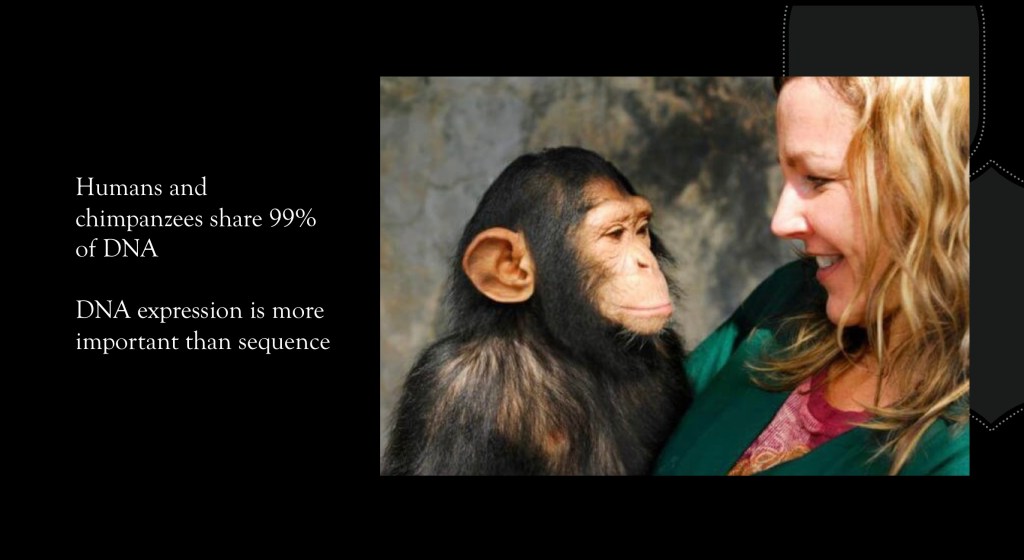
Humans and our closest relatives, chimpanzees share 99.0% of our DNA. The differences between species illustrate how gene expression is more important than DNA sequence.

A gene is a functional unit of DNA coding for a specific product. An allele is a variant copy of a gene. The pea plant has one gene coding for flower color and two alleles of that gene, one for purple and one for white.
Most traits involve more than one gene and multiple alleles.

DNA is a three letter code for protein synthesis. Thereare four nucleic acids, Arginine, Cytosine, Guanine, and Thymine. These are represented by the letters A T G C. Every three letter group corresponds to one of the 20 amino acids. There are between 1 – 6 codons coding for a given amino acid.. GAA or GAG code for Glutamine for example. Proteins are chains of amino acids.
CCC-AAA-GAA would code for the amino acid chain Proline-Lysine-Glutamine.

The Central Dogma of cell biology
DNA makes RNA
RNA makes Proteins
Under the correct signal the DNA gene will code for formation of a single stranded segment of messenger RNA. The mRNA leaves the nucleus and in the cellular cytosol attaches to a ribosome. The sequence is “read” with formation of an amino acid chain. This process is highly dependent on environment and Epigenetic factors determining which genes may be turned on or off. Nature vs nurture is really a false dichotomy because both are dynamic interactive processes.

Most of what we know about heredity as a risk factor comes from twin studies. These studies are possible because large registries of identical (monozygotic) and non identical (dizygotic) twins have been collected by centers in the US and elsewhere in the world.
Heredity studies are observations of traits, not DNA sequence. From there inferences can be made to certain genes or groups of genes involved. Monozygotic or dizygotic twins, and family groups will have differing expected inheritable traits. Because of genetic similarities twins provide a unique opportunity to study inherited trait patterns.

Non identical dizygotic twins result from a single ovum which has split and are fertilized from two different sperm. Dizygotic twins share 50% of their DNA.
Monozygotic identical twins result from one ovum and one sperm which splits after fertilization. They share 100% of their DNA.

Based on combined studies from multiple centers inherited risk liabilities to addictive drugs have been calculated. Average liability due to heredity is about 50%. A strength of the findings is they are highly replicable. Results from one center to another are in close agreement.

Substance addiction is a complex multi factorial condition. Genetic load results from the combined influence of multiple alleles. Gene expression is modulated by developmental, environmental, personality traits, comorbid conditions, drug availability, pharmacology, stress, resiliency and other risk factors

This model illustrates genetic contribution related to severity of combined environmental influence. The dashed line represents an individual with high genetic risk. Progression to a disease state in a high risk individual is more likely to manifest at an earlier point and at lower combined environmental stress compared to a low genetic risk individual.

Switching gears to look at examples of individual genes and DNA sequences associated with addiction risk.
The most simple and useful genetic variance is the Single Nucleotide Polymorphism. An SNP is when a single base is substituted for another along a length of DNA. For example G—A or T—C switches.
Technology now allows the entire genome of an individual to be searched for SNPs associated with a trait such as nicotine addiction. Many thousands of samples can be included in a Genome Wide Association Study.
This is a very powerful technique when applied to complex multi genetic conditions like drug addiction. Because it requires no hypothetical gene or mechanism it can discover unexpected factors leading to addiction.
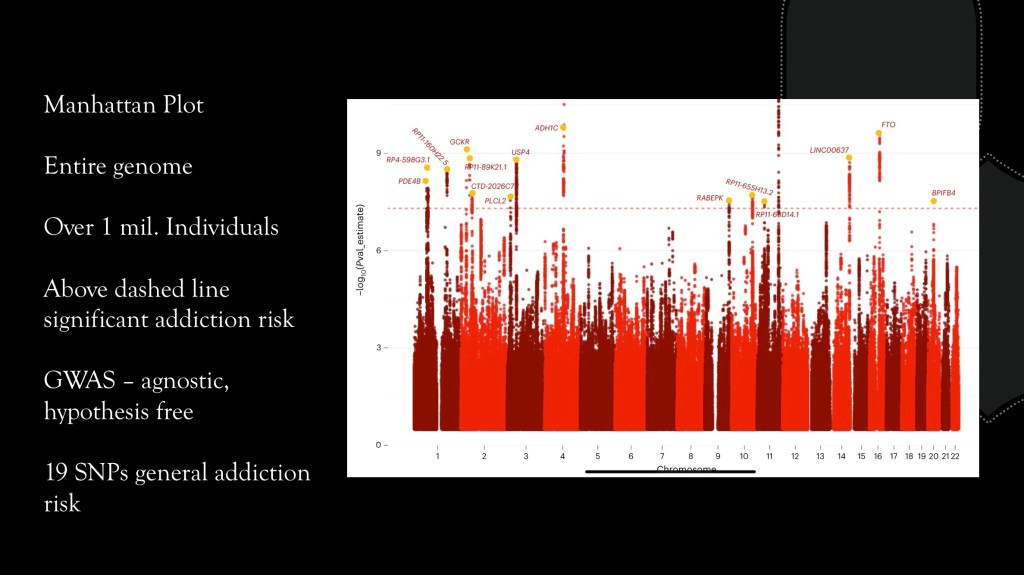
This graph represents the entire composite genomes of over 1 million individuals arranged by chromosome. The vertical lines above the dashed line represent genetic variants found almost exclusively in individuals with current or past drug addiction. 19 SNPs were identified in this study.
Among the genes identified are:
PDE14 a gene involved in neurotransmitter signaling and implicated in bipolar disorder and schizophrenia.
ZNF512 a gene involved in multiple neurological diseases
SIX3 a gene involved in development of the embryonic forebrain.
In addition to finding previously unknown cellular pathways involved there is the potential to develop testing to screen for individuals at high risk for development of drug addiction.

Another promising role for genetic testing is to predict drug response for therapy. The drug Naltrexone is currently used to aid in relapse prevention for alcohol use disorder. The drug has been shown to be only moderately effective. This study compared people with two different alleles, ASP40 and ASN40 for a gene coding a subset of the mu opioid receptor, the site of naltrexone action.
This placebo controlled study found that people carrying the ASP40 gene had a significantly better response to naltrexone compared with the other genetic variant. Testing for this gene may help guide treatment options in the near future. Similar testing is currently used to guide treatment for specific antidepressants.
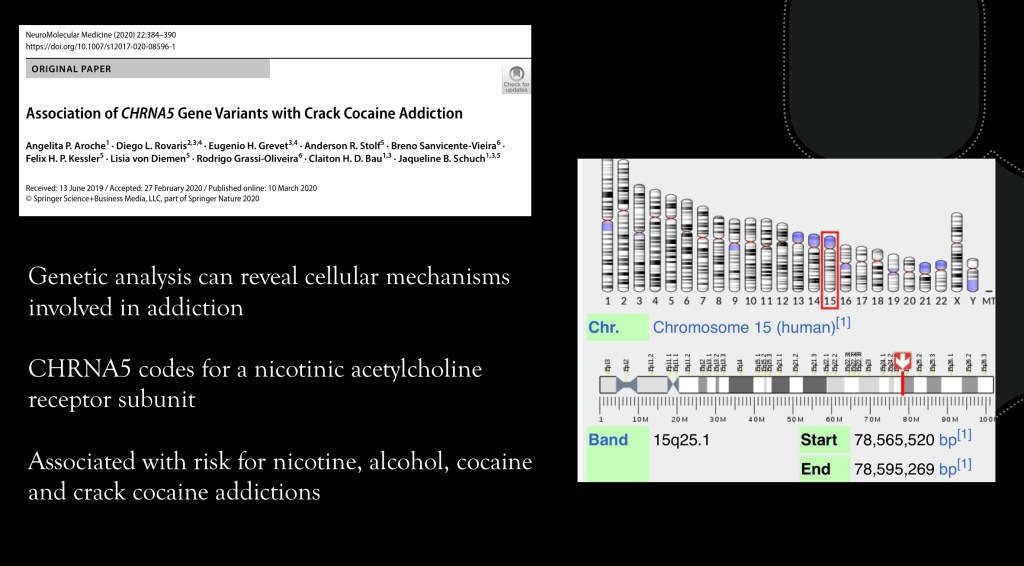
The gene CHRNA5 is found on chromosome 15 and codes for a subunit of the acetylcholine neurotransmitter receptor. It has previously been identified with nicotine addiction. This study looked at this gene in crack cocaine addiction and found a strong correlation between a variant allele of CHRNA15 and development of crack cocaine addiction. This suggests a mechanism leading to addiction risk which was not suspected
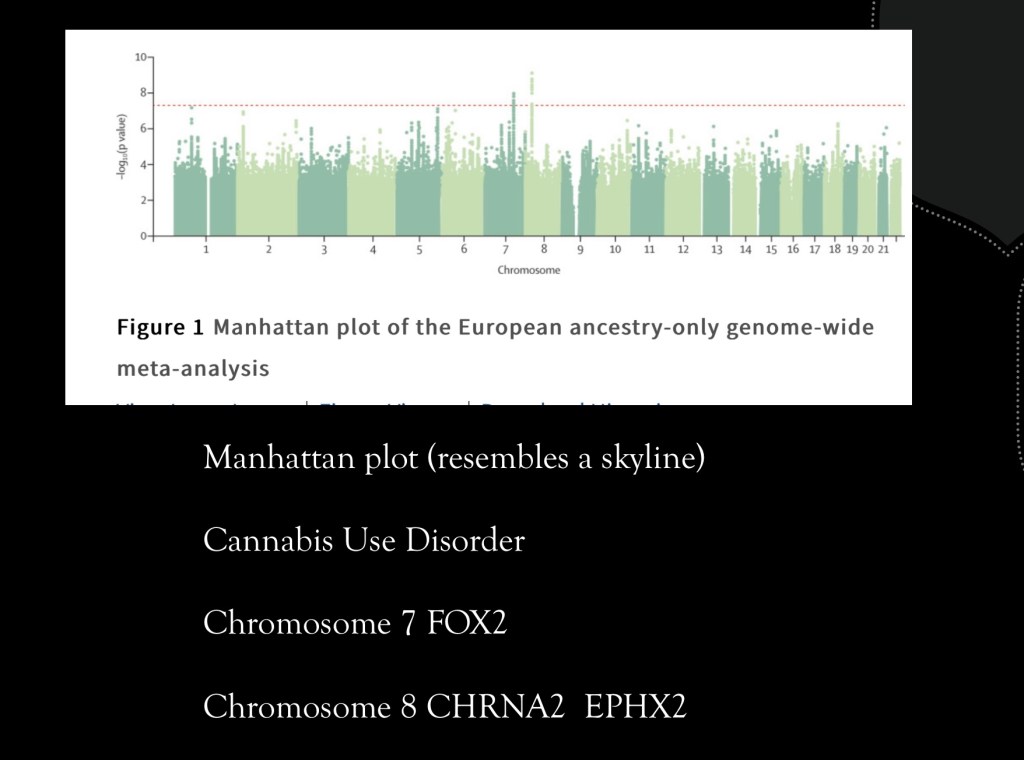
This GWAS study looked at genetic markers associated with Cannabis Use Disorder. While cannabis use is widespread only a minority progress to cannabis use disorder. Heritability studies suggest a strong genetic linkage in progression of the disease. This study was able to identify specific genes involved. The linked genes are FOX2 on chromosome 7 and two genes on chromosome 8. While there is some association with mental illness with several of these genes the precise mechanism associated with use disorder is unclear.
While cannabis has traditionally been viewed as a “soft” drug there is increasing recognition that some individuals are predisposed to developing a serious disorder similar to that seen in other addictive drugs. Heredity appears to be a strong predictor of cannabis addiction risk.
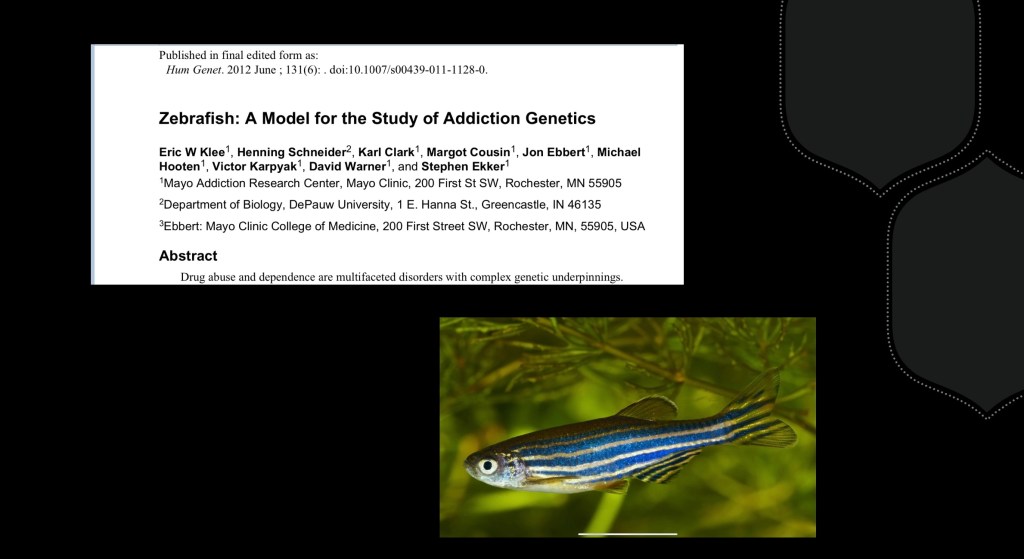
A home aquarium favorite, the zebra fish is now doing its part at the frontiers of addiction research.
………………………………………………………………………………………………………………………
Advances in research efforts have verified a strong role for genetics and gene expression in substance use disorders. Addiction results from the interaction of environmental stressors, pharmacology, and genetic liability. The relative impact of any of these can best be understood as unique at the individual level.
Genetic research has the potential for development of promising new tools. Genetic markers to identify risk can aid in prevention before a problematic addiction develops. Pharmacogenetics, genetic testing to optimize treatment efforts can be developed. Newer techniques can identify overlooked biological pathways leading to better understanding and therapeutic targets.
Note: Heritability estimates of a complex behavioral phenotype are subject to significant limitations. The effects of environment on gene expression and effects resulting from multiple alleles with low individual penetrance make individual risk calculations inherently imprecise. A 50% liability does not mean that one has a 50% chance of developing SUD with a positive family history. It is however reasonable to conclude that our genetic makeup is a substantial factor in risk of developing a substance use disorder. It is also important to note that SUD as currently defined is non linear and broadly defined. It involves a spectrum ranging from minor to severe and may represent a short term pattern which resolves with minimal impact over time. 11/19/23
Education and information purposes only, this post is. No commercial or institutional interest. Images and data obtained from sources freely obtained on the World Wide Web. This post should not be considered professional or medical advice.
Comments and feedback are always welcome.
JK 11/23
References
Genetics
………………………………………………………
The Genetics of Addictions: Uncovering the Genes
David Goldman, Gabor Oroszi, and Francesca Ducci
Published Online:1 Aug 2006https://doi.org/10.1176/foc.4.3.401
https://focus.psychiatryonline.org/doi/full/10.1176/foc.4.3.401
…………………………………………………………….
The genetics of addiction
Nora D. Volkow & Maximilian Muenke
https://link.springer.com/article/10.1007/s00439-012-1173-3
…………………………………………………………….
https://en.wikipedia.org/wiki/Central_dogma_of_molecular_biology
……………………………………………………………
https://link.springer.com/article/10.1007/s00439-012-1164-4
A common genetic network underlies substance use disorders and disruptive or externalizing disorders
Published: 11 April 2012 volume 131, pages 917–929 (2012)
……………………………………………………………….
Epigenetic Mechanisms of Drug Addiction
as:Neuropharmacology. 2014 Jan; 76(0 0): 10.1016/j.neuropharm.2013.04.004. Published online 2013 Apr 30.
https://www.ncbi.nlm.nih.gov/pmc/articles/PMC3766384/
Gene Expression in the Addicted Brain
Zhifeng Zhou,1 Mary-Anne Enoch, and David Goldman
Author manuscript; available in PMC 2015 May 11.Published in final edited form
Int Rev Neurobiol.
https://www.ncbi.nlm.nih.gov/pmc/articles/PMC4427035/
…………………………………………………………
Cellular basis of memory for addiction
Translational research Pages 431-443 | Published online: 01 Apr 2022
Eric Nestor
https://www.tandfonline.com/doi/full/10.31887/DCNS.2013.15.4/enestler
…………………………………………………………
Neuronal RNA-binding protein HuD regulates addiction-related gene expression and behavior
R. J. Oliver, J. L. Brigman, F. Bolognani, A. M. Allan, J. L. Neisewander, N. I. Perrone-Bizzozero
https://onlinelibrary.wiley.com/doi/full/10.1111/gbb.12454
……………………………………………………………….
Comparative investigations of the genesis of alcoholism and drug addiction
Author: R. Battegay
Pages: 7 to 17
Creation Date: 1961/01/01
United Nations office on drugs and crime
https://www.unodc.org/unodc/en/data-and-analysis/bulletin/bulletin_1961-01-01_2_page003.html
https://www.unodc.org/unodc/en/data-and-analysis/bulletin/bulletin_1961-01-01_2_page003.html
……………………………………………………………….
1953 Psychiatry – genetics and addiction
………………….
1928 Manual of psychiatry
“…………………………………………………
…………………………………………………….
Human Genetics of Addiction: New Insights and Future Directions
Dana B. Hancock, PhD1, Christina A. Markunas, PhD1, Laura J. Bierut, MD2, and Eric O. Johnson, PhD3
1Behavioral and Urban Health Program, Behavioral Health and Criminal Justice Division, RTI
Curr Psychiatry Rep. ; 20(2): 8. doi:10.1007/s11920-018-0873-3.
……………………………………………………
A Novel Precision Approach to Overcome the “Addiction Pandemic” by Incorporating Genetic Addiction Risk Severity (GARS) and Dopamine Homeostasis Restoration
Kenneth Blum et Al
https://www.mdpi.com/2075-4426/11/3/212
……………………………………………………
Zebrafish: A Model for the Study of Addiction Genetics
Eric W Klee1, Henning Schneider2, Karl Clark1, Margot Cousin1, Jon Ebbert1, Michael
Hooten1, Victor Karpyak1, David Warner1, and Stephen Ekker1
1Mayo Addiction Research Center, Mayo Clinic, 200 First St SW, Rochester, MN 55905
Hum Genet. 2012 June ; 131(6): . doi:10.1007/s00439-011-1128-0.
………………………………………………………..
Genetics of dopamine receptors and drug addiction
Philip Gorwood · Yann Le Strat · Nicolas Ramoz ·
Hum Genet
DOI 10.1007/s00439-012-1145-7
https://d1wqtxts1xzle7.cloudfront.net/48790730/
………………………………………………………..
In Search of Reward Deficiency Syndrome (RDS)-free Controls: The “Holy Grail” in Genetic Addiction Risk Testing
Kenneth Blum1,2,3,4,5,6,7,8,9,*, David Baron1, Lisa Lott7, Jessica V. Ponce7, David Siwicki7, Brent Boyett8, Bruce Steinberg10, Edward J. Modestino10, Lyle Fried11, Mary Hauser6,
……………………………………………………..
The Genetic Basis of Addictive Disorders
Francesca Ducci, MD, PhDa and David Goldman, MDb,*
Psychiatr Clin North Am. 2012 June ; 35(2): 495–519. doi:10.1016/j.psc.2012.03.010.
……………………………………………………..
Pharmacogenetic approaches to the treatment of alcohol addiction
Markus Heilig*, David Goldman‡, Wade Berrettini§, and Charles P. O’Brien§ *Laboratory of Clinical and Translational Studies, National Institute on Alcohol Abuse
Nat Rev Neurosci. ; 12(11): 670–684. doi:10.1038/nrn3110.
…………………………………………………………….
Chapter 2
The Genetic Basis of Addiction
Chad Epps and Elizabeth Laura Wright
………………………………………………………………..
A Functional Polymorphism of the μ-Opioid Receptor Gene is Associated with Naltrexone Response in Alcohol-Dependent Patients
- David W Oslin, Wade Berrettini, Henry R Kranzler, Helen Pettinati, Joel Gelernter, Joseph R Volpicelli & Charles P O’Brien
https://www.nature.com/articles/1300219
………………………………………………………….
Molecular Structure of Nucleic Acids: A Structure for Deoxyribose Nucleic Acid
- J. D. WATSON & F. H. C. CRICK
volume 171, pages 737–738 (1953)
Under paywall
……………………………………………………….
Humans and chimpanzees share 99% of the same DNA. This is the 1% difference
Swiss Institute of Bioinformatics | January 18, 2021
……………………..,,,…,,..,,,,,,,………………….
Ranking the Harm of Psychoactive Drugs Including Prescription Analgesics to Users and Others–A Perspective of German Addiction Medicine Experts
Thomas Alberti
Front. Psychiatry, 26 October 2020
Sec. Addictive Disorders
Volume 11 – 2020 | https://doi.org/10.3389/fpsyt.2020.592199
https://www.frontiersin.org/articles/10.3389/fpsyt.2020.592199/full
……………………………………………………………..
Open questions: How many genes do we have?
Steven L. Salzberg
Salzberg BMC Biology (2018) 16:94 https://doi.org/10.1186/s12915-018-0564-x
https://www.ncbi.nlm.nih.gov/pmc/articles/PMC6100717/pdf/12915_2018_Article_564.
………………………………………………………………..
The Genetics of Alcohol Dependence: Twin and SNP-Based Heritability, and Genome-Wide Association Study Based on AUDIT Scores
Hamdi Mbarek,1* Yuri Milaneschi,2 Iryna O. Fedko,1
Neuropsychiatric Genetics
…………………………………………………………..
Multivariate genome-wide association meta-analysis of over 1 million subjects identifies loci underlying multiple substance use disorders
- Alexander S. Hatoum, Sarah M. C. Colbert, Emma C. Johnson, Spencer B. Huggett,Joseph D. Deak, Gita A. Pathak, Mariela V. Jennings, Sarah E. Paul, Nicole R. Karcher,Isabella Hansen,
https://www.nature.com/articles/s44220-023-00034-y
………………………………………………………………….
A Functional Polymorphism of the μ-Opioid Receptor Gene is Associated with Naltrexone Response in Alcohol-Dependent Patients
- David W Oslin, Wade Berrettini, Henry R Kranzler, Helen Pettinati, Joel Gelernter, Joseph R Volpicelli & Charles P O’Brien
https://www.nature.com/articles/1300219/
……………………………………………………………….
Association of CHRNA5 Gene Variants with Crack Cocaine Addiction Angelita P. Aroche1 · Diego L. Rovaris2,3,4 · Eugenio H. Grevet3,4 · Anderson R. Stolf5 ·
NeuroMolecular Medicine (2020) 22:384–390
……………………………………………………………….
Genetics: The Blueprint of Health and Disease
National Institute on Drug Abuse
https://nida.nih.gov/publications/drugfacts/genetics-epigenetics-addiction
………………………………………………………………..
A large-scale genome-wide association study meta-analysis of cannabis use disorder
Emma C Johnson, PhD , Ditte Demontis, PhD ,Thorgeir E Thorgeirsson, PhD
Lancet
Dec 2020 lancet psychiatry
https://www.thelancet.com/journals/lanpsy/article/PIIS2215-0366(20)30339-4/fulltext
…………………………………………………………
 Sober Synthesis
Leave a comment