
Part 2
pathology, addiction, and treatment
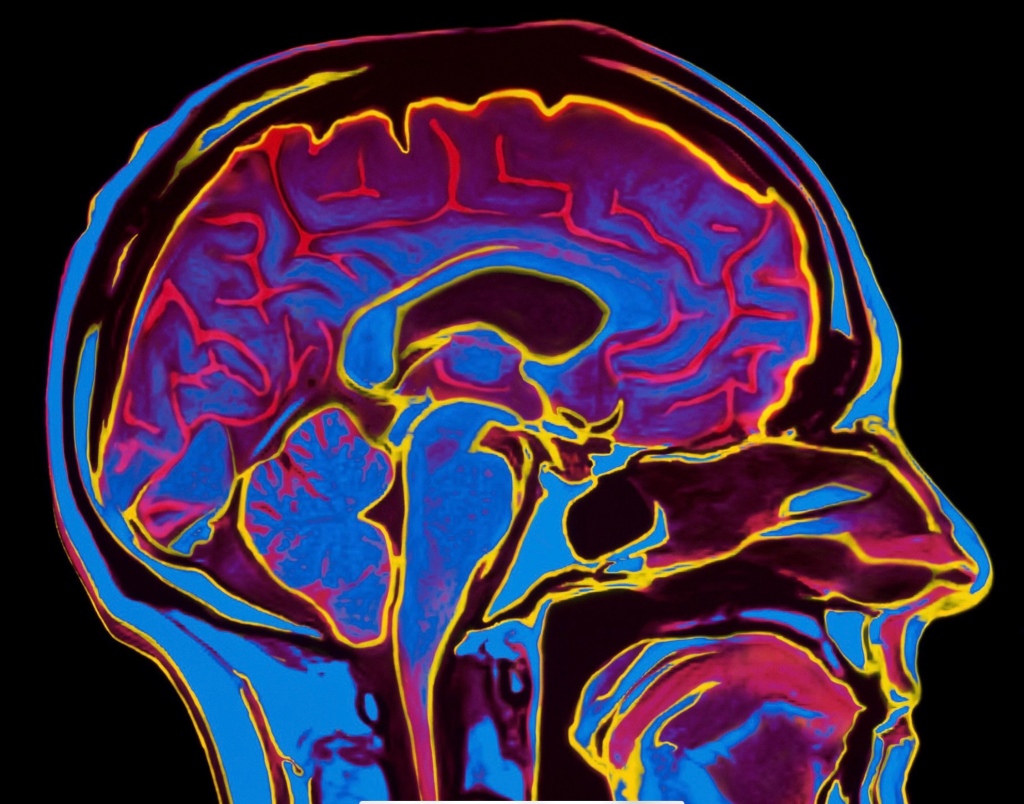
This post focuses on neuropathology, addiction, and treatment options related to amphetamine use. Illicit methamphetamine is manufactured and distributed on an industrial scale primarily by large drug cartels. The recent spike in methamphetamine supply coincides with the shift to manufacture of the synthetic opioid fentanyl around 2012.
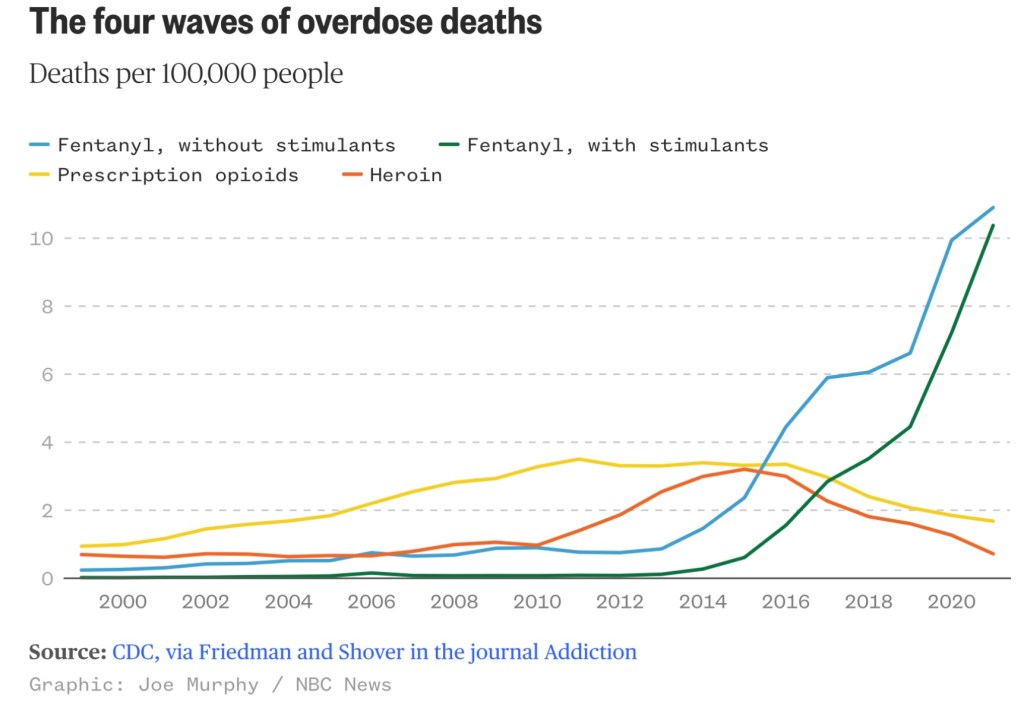
Deaths from unintentional drug overdose are at unprecedented record levels. Despite media messages prescription drugs are minor contributors and declining. By far illegally manufactured fentanyl and methamphetamine outnumber all other causes of drug death and overdose. Stimulant overdose death is most often due to intentional or unintentional mixture of amphetamine or cocaine with fentanyl and other additives. Street preparations are often mixed or sold as counterfeit pills or powders.
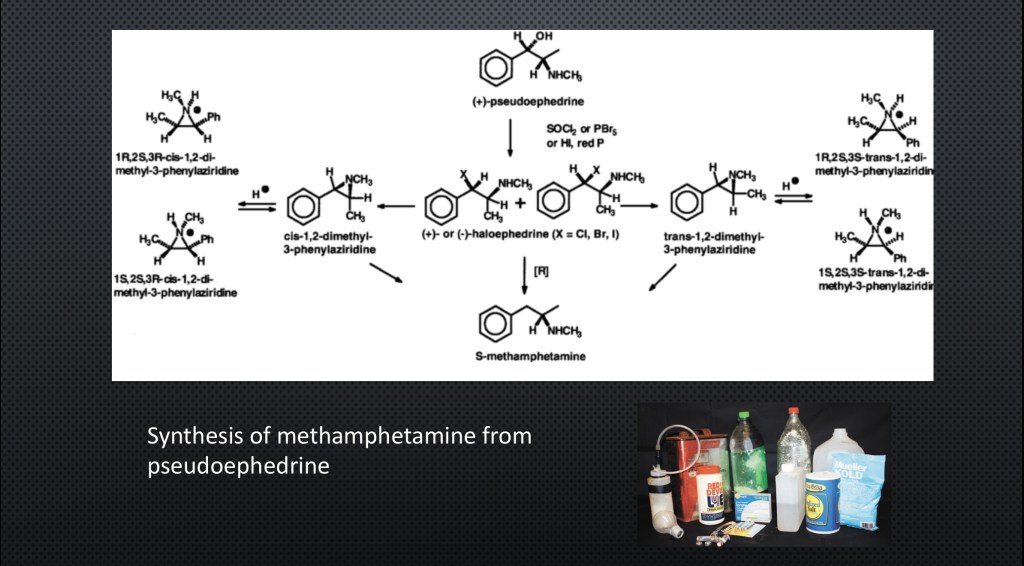
The above diagram shows the chemical steps needed for synthesis of methamphetamine from phenylephrine (Sudafed).
Sudafed is now restricted in many locations and most methamphetamine is now imported from illicit labs using more sophisticated chemical methods and equipment.
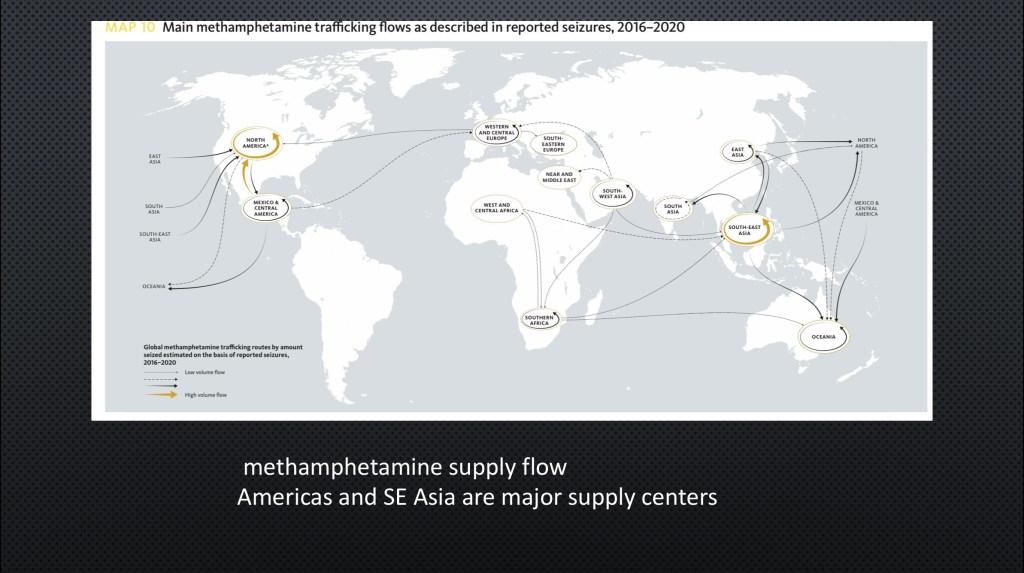
WHO flow chart of methamphetamine supply chains. Major export centers are located in Southeast Asia and the Americas. Due to economy of scale, production and smuggling supply is cost efficient and highly profitable despite some loss due to law enforcement efforts.
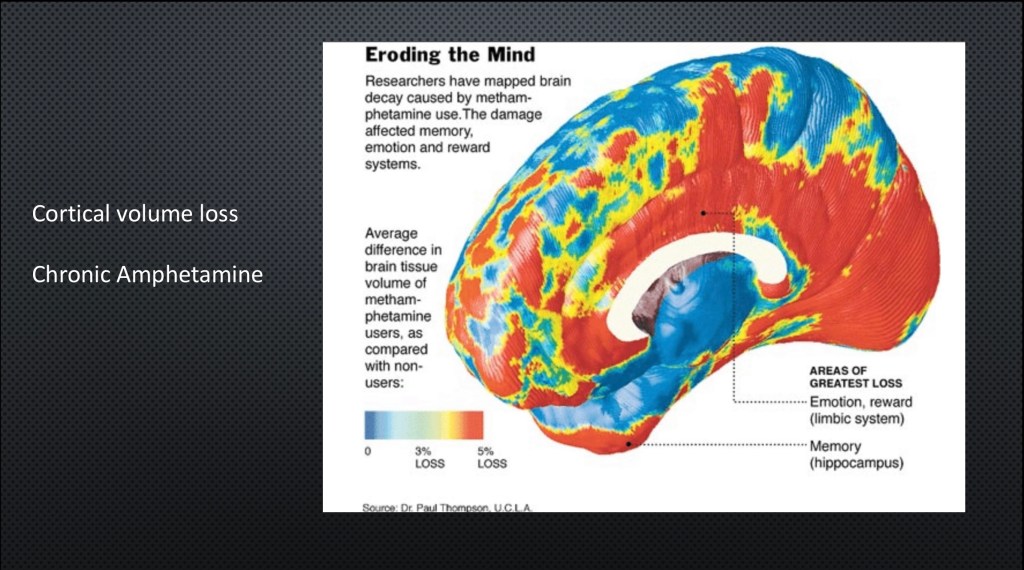
One of the most significant consequences of long term higher dose amphetamine use is neurotoxicity. Because of major shifts in function cellular apoptosis, cell destruction, may occur. The above map represents composite data of cellular volume loss due to amphetamine use. Areas most affected are the hippocampus and limbic system. Users frequently report short term memory loss, cognitive deficits, and emotional dysregulation.
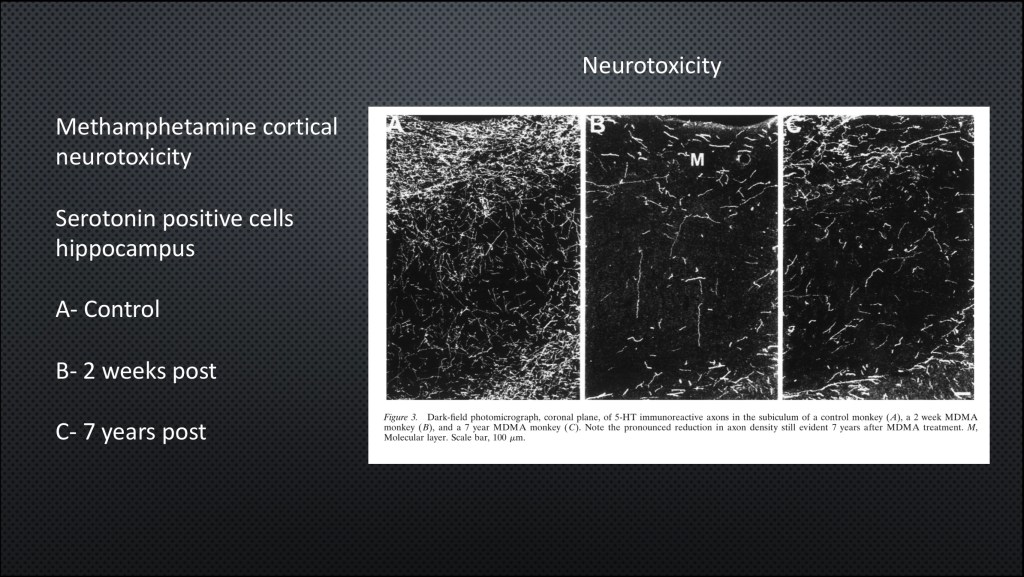
Postmortem samples of serotonin labeled brain sections in the primate cortical hippocampus after 7 week amphetamine treatment. From left to right are controls, 2 weeks post, and 7 years post exposure demonstrating the irreversible nature of tissue loss.
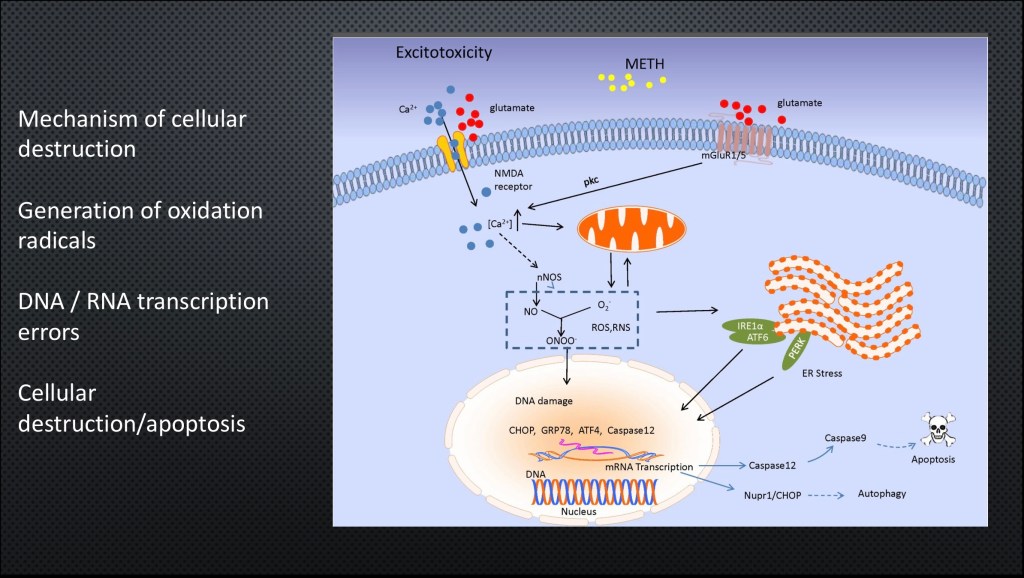
Diagram of cellular mechanisms underlying neurotoxicity. Amphetamines cause marked increases in excitatory glutamate production and shifts in intracellular Calcium ion. This results in generation of oxidative free radicals, superoxide, nitric oxide and peroxynitrite. Electron transfer from cellular components such as DNA due to oxidative stress results in cellular damage and eventual cell death.
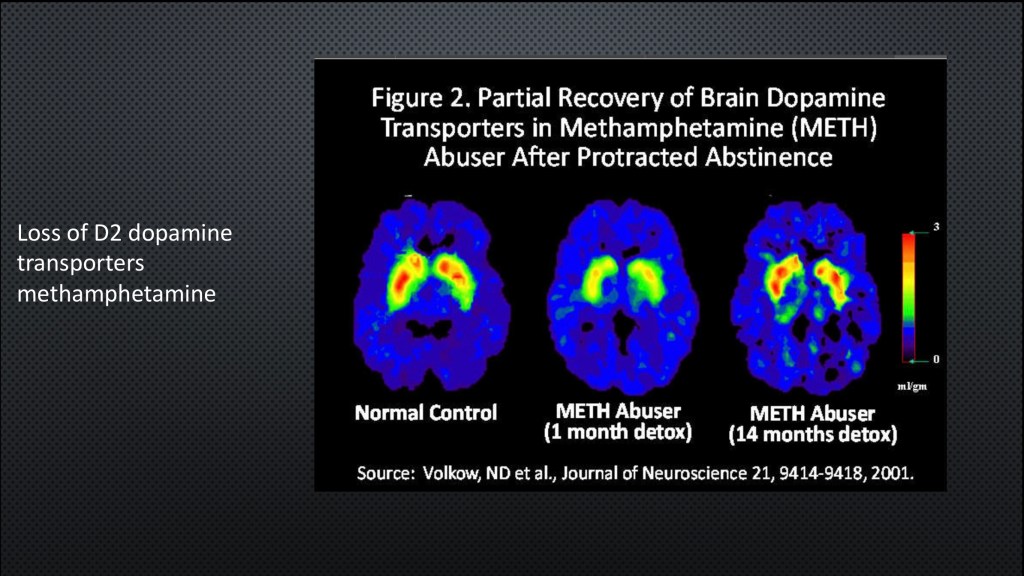
Additional neuroplastic changes occur in key areas of the brain. This image is one of the most frequently reproduced in addiction literature and presentations. It is from a study published in 2001 by researchers at the NIH with Nora Volkow as the lead author. It was one of the first to demonstrate long term changes in functional brain deficits occurring in addiction supporting a growing body of evidence for the brain disease model of addiction.
These are from a PET study on Methamphetamine users in early and late abstinence. A radioactive agent was given binding to dopamine D2 receptors. Red indicates greater concentration of receptors. Control is on the left. In the center recently detoxed individuals show markedly decreased dopamine receptors in the Striatum, a key component of the reward system. This partially recovers at 2 years abstinence.
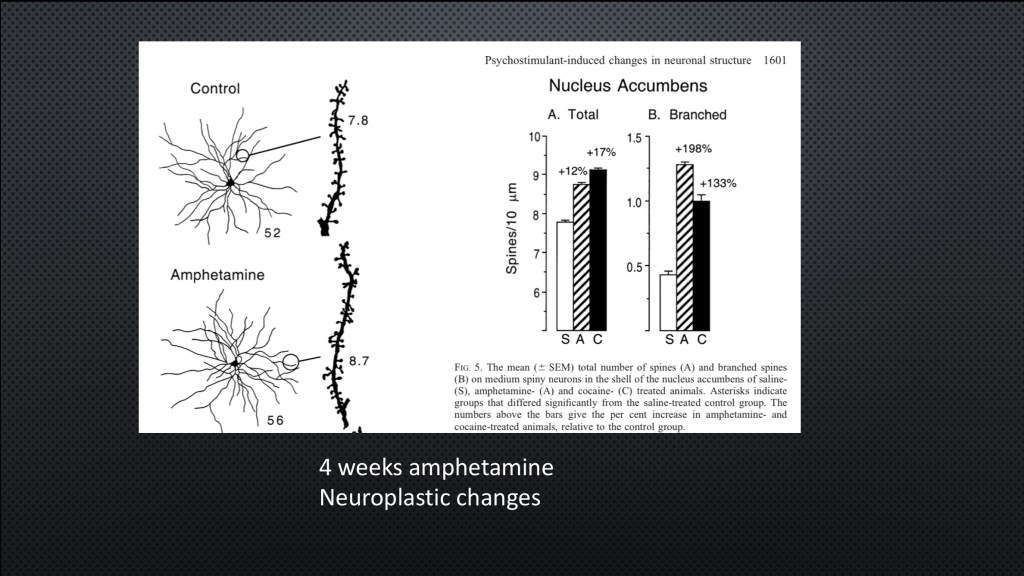
Another long term neuroplastic change. This is from animal experiments following 4 weeks of amphetamine administration. Shown are diagrams of neurons in the Nucleus Accumbens. The little knob like things along the dendrites are dendritic spines. There are more of these after amphetamine. This means more synapses and increased sensitivity of the neuron.
These cellular changes have been linked with increased drug seeking behavior in lab animals. Sensitization is thought to be a key component in progressive substance addiction and relapse in humans.
This mechanism is most pronounced in stimulant use.
The most commonly prescribed prescription amphetamine is Adderall containing mixed d- and l- amphetamine salts and related drugs prescribed for ADHD in children and adults.
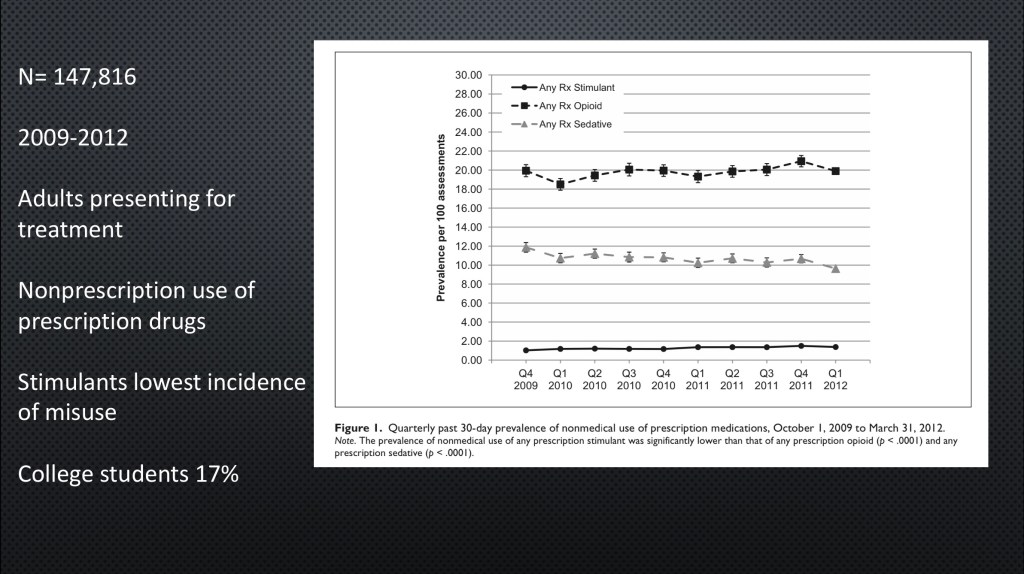
The above study looked at adults presenting for addiction treatment and reporting non prescription drug use. Of the types reported stimulants were the lowest reported. Opiates and sedatives were much more common.
While this represents only a subset of prescription diversion and misuse it indicates that use in adults requiring treatment is lower than other addictive drugs. Non prescription use has been reported to be common among college students as a study aid. Reports indicate a rate as high as 17% among undergraduates. Interestingly additional studies have not shown higher academic achievement in user groups.
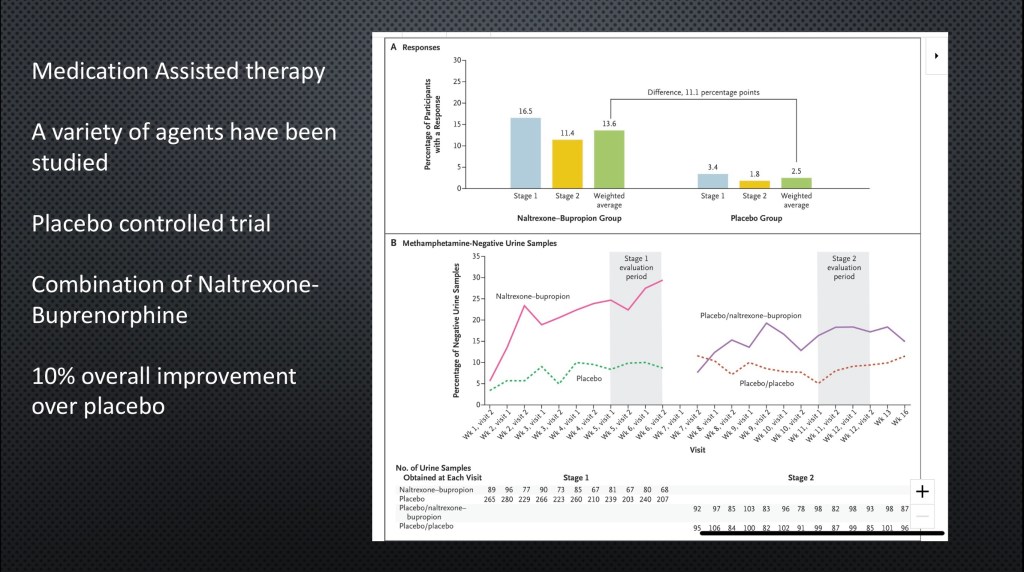
At this time there is no useful pharmacotherapy to aid in preventing relapse or withdrawal symptoms in stimulant addiction. Several strategies have been tested. This study was a placebo controlled randomized trial for a total of 13 weeks. The study employed a combination of injected naltrexone and oral bupropion. Mild improvement about 10% vs placebo was found for relapse prevention in the treated group.
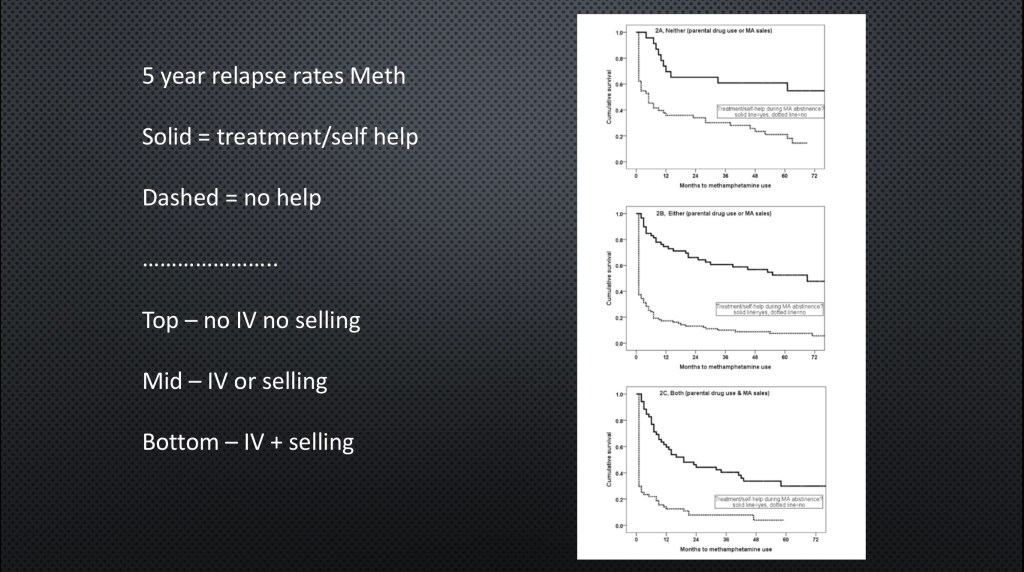
This long term study looked at relapse rates over a five year period following discharge from a treatment facility. They were divided into three risk groups by history of prior drug selling and/or IV drug use. They also looked at if the subject had received any sort of treatment or self help involvement after discharge. Treatment or self help involvement resulted in a significantly better outcome. Prior history of drug sales or IV use was a significant risk factor in predicting relapse.
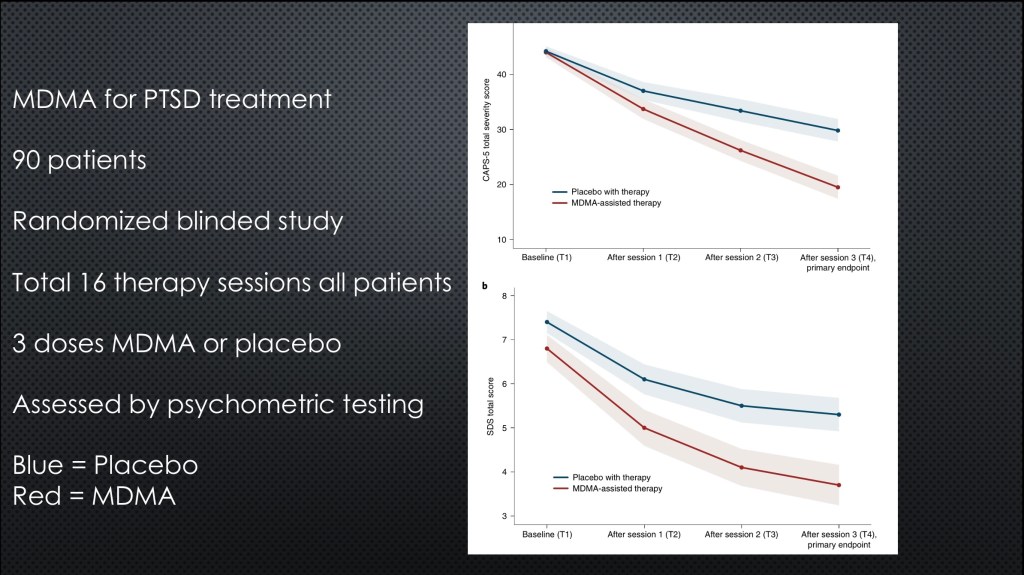
This recent study was a randomized double blinded placebo controlled trial to evaluate efficacy of the amphetamine derivative MDMA (ecstasy) as an adjunct to psychotherapy in patients with severe PTSD. MDMA is an amphetamine derivative with strong activity in Serotonin and Dopamine pathways.
All subjects received 16 psychotherapy sessions. A total of 3 doses of either MDMA or placebo was administered during the trial period along with therapy.
Results are as shown above with significantly increased reduction of symptoms in the MDMA group. No demographic or confounding factors were observed.
,,,,,,,,,,,,,,,,,,,,,,,,,,,,,,,,,,,,,,,,,,,,,,,,,,,,,,,,,,,,,,,,,,,,,,,,,,,,,
The neurobiology of amphetamines and the pathophysiology of dependence and addiction are well defined. Although there have been some advances in pharmacotherapy for opiates and alcohol there are none currently for Amphetamines. Psychosocial and support/self help measures offer high probability of disease remission and significant harm reduction.
The use of MDMA as an adjunct in treatment for PTSD is gaining rapid acceptance and has been proven in clinical trials. In the study noted history of Alcohol and substance use disorder did not affect therapeutic outcomes and would not present a barrier to treatment.
,,,,,,,,,,,,,,,,,,,,,,,,,,,,,,,,,,,,,,,,,,,,,,,,,,,,,,,,,,,,,,,,,,,,,,,,
Thank you for your consideration in reviewing this post. Comments and suggestions are welcome.
For educational and information purposes only. No commercial or institutional interest. All data and images obtained from sources freely available on the World Wide Web. This post should not be considered medical or professional advice.
REFERENCES
Amphetamine Modulates Glutamatergic Neurotransmission through Endocytosis of the Excitatory Amino Acid Transporter EAAT3 in Dopamine Neurons
Suzanne M. Underhill1, David S., Spencer D. Watts,
Neuron. 2014 July 16; 83(2): 404–416. doi:10.1016/j.neuron.2014.05.043.
…………………………………………………..
Amphetamine, past and present – a pharmacological and clinical perspective
David J Heal1, Sharon L Smith1, Jane Gosden1 and David J Nutt
Journal of Psychopharmacology
27(6) 479–496 2023
……………………………………….
Amphetamine toxicities Classical and emerging mechanisms Bryan K. Yamamoto1, Anna Moszczynska, and Gary A. Gudelsky
Ann N Y Acad Sci. 2010 February ; 1187: 101–121. doi:10.1111/j.1749-6632.2009.05141.x.
…………………………………………
Amphetamine-related drugs neurotoxicity in humans and in experimental animals: Main mechanisms
Rosario Moratallo*, Amit Khairnar , Nicola Simola , Noelia Granado et Al
https://www.sciencedirect.com/journal/progress-in-neurobiology
………………………………………………………
Treatment for amphetamine withdrawal
Shoptaw SJ, Kao U, Heinzerling K, Ling W
Cochrane Database of Systematic Reviews 2009, Issue 2. Art. No.: CD003021.
…………………………………………….
The Neuropsychology of Amphetamine and Opiate Dependence: Implications for Treatment
Karen D Ersche and Barbara J Sahakian
School of Clinical Medicine, Department of Psychiatry, University of Cambridge,
………………………………………………
Psychological treatments for stimulant misuse, comparing and contrasting those for amphetamine dependence and those for cocaine dependence
Frank J. Voccia and Iván D. Montoyab
aFriends Research Institute, Baltimore, Maryland, USA
Curr Opin Psychiatry. 2009 May ; 22(3): 263–268. doi:10.1097/YCO.0b013e32832a3b44.
……………………………………………………….
Pharmacogenetic Treatments for Drug Addiction: Cocaine, Amphetamine and Methamphetamine
Colin N. Haile, Ph.D., Thomas R. Kosten, M.D., and Therese A. Kosten, Ph.D.
Am J Drug Alcohol Abuse. 2009 ; 35(3): 161–177. doi:10.1080/00952990902825447.
………………………………………………………..
Substitution therapy with amphetamine-isotherapic attenuates amphetamine toxicological aspects of addiction
Volume 690, 18 January 2019, Pages 138-144 neuroscience letters
https://www.sciencedirect.com/science/article/abs/pii/S0304394018306773
………………………………………………..
Psychostimulant addiction treatment
Karran A. Phillips, MD, MSc, David H. Epstein, PhD, and Kenzie L. Preston, PhD National Institute on Drug Abuse, Intramural Research Program, National Institutes of Health
Neuropharmacology. 2014 December ; 87: 150–160. doi:10.1016/j.neuropharm.2014.04.002.
…………………………………………………………..
……………………………………………………………
It’s called overamping”: experiences
of overdose among people who use methamphetamine
Robert W. Harding1, Katherine T. Wagner2, Phillip Fiuty3, Krysti P. Smith1, Kimberly Page
Harding et al. Harm Reduction Journal (2022) 19:4
……………………………………………………….
Nucleus accumbens shell neurons’ early sensitivity to cocaine is associated with future increases in drug intake
Author links open overlay panel
https://www.sciencedirect.com/science/article/
……………………………………….
………………………………………….
https://www.cbsnews.com/news/meth-laced-fake-adderall-pills-seizure-staggering-
……………………………………….
Chronic treatment with 9-tetrahydrocannabinol enhances the locomotor response to amphetamine and heroin. Implications for vulnerability to drug addiction
S. Lamarque a, K. Taghzouti b, H. Simon a,*
a Laboratoire de Neuropsychobiologie des De ́sadaptations, Universite ́ Victor Segalen Bordeaux 2,
Neuropharmacology 41 (2001) 118–129
………………………………………..
……………………………………..
Dark Times: The Role of Negative Reinforcement in Methamphetamine Addiction
Front. Psychiatry, 17 March 2020
Sec. Addictive Disorders
Volume 11 – 2020 | https://doi.org/10.3389/fpsyt.2020.00114
https://www.frontiersin.org/articles/10.3389/fpsyt.2020.00114/full
……………………………………………………….
Epigenetic mechanisms involved in methamphetamine addiction
Hang Wang
Xianghuan Dong
Front. Pharmacol., 26 August 2022
Sec. Neuropharmacology
Volume 13 – 2022 | https://doi.org/10.3389/fphar.2022.984997
https://www.frontiersin.org/articles/10.3389/fphar.2022.984997/full
……………………………………………………….
Methamphetamine addiction vulnerability: The glutamate, the bad and the ugly
Karen K. Szumlinski1,2, Kevin D. Lominac1, Rianne R. Campbell1, Matan Cohen1, Elissa K. Fultz1, Chelsea N. Brown1, Bailey W. Miller1, Sema G. Quadir1, Douglas Martin
Biol Psychiatry. 2017 June 01; 81(11): 959–970. doi:10.1016/j.biopsych.2016.10.005.
…………………………………………………………..
September 22, 2021
Methamphetamine Use, Methamphetamine Use Disorder, and Associated Overdose Deaths Among US Adults
Beth Han, MD, PhD, MPH1; Wilson M. Compton, MD, MPE1; Christopher M. Jones, PharmD, DrPH, MPH2; et al
JAMA Psychiatry. 2021;78(12):1329-1342. doi:10.1001/jamapsychiatry.2021.2588
………………………………………………………………..
The pharmacology and toxicology of “ecstasy” (MDMA) and related drugs
Harold Kalant
CMAJ 2001;165(7):917-28
…………………………………………………………….
Bupropion and Naltrexone in Methamphetamine Use Disorder
List of authors.
- Madhukar H. Trivedi, M.D., Robrina Walker, Ph.D., Walter Ling, M.D., Adriane dela Cruz, M.D., Ph.D., Gaurav Sharma, Ph.D., Thomas Carmody, Ph.D., Udi E. Ghitza, Ph.D., Aimee Wahle, M.S., Mora Kim, M.P.H., Kathy Shores-Wilson, Ph.D., Steven Sparenborg, Ph.D., Philli
- N Engl J Med 2021; 384:140-153
DOI: 10.1056/NEJMoa2020214
https://www.nejm.org/doi/full/10.1056/NEJMoa2020214
…………………………………………………………….
Neuropharmacology. 2013 January ; 64(1): 452–463. doi:10.1016/j.neuropharm.2012.06.021.
Cognitive Enhancement as a Treatment for Drug Addictions Mehmet Sofuoglu1, Elise E. DeVito1, Andrew J. Waters2, and Kathleen M. Carroll1
1Yale University, School of Medicine, Department of Psychiatry and VA Connecticut
…………………………………………………….
Emerald Article: Examining the temporal relationship between methamphetamine use and mental health comorbidity
Nicole K. Lee, Angela M. Harney, Amy E. Pennay
Advances in Dual Diagnosis, Vol. 5 Iss: 1 pp. 23 – 31
Permanent link to this document:
http://dx.doi.org/10.1108/17570971211225145
……………………………………………………..
UN report amphetamine and stimulants 2020
……………………………………………………..
The Role of Substance Use Coping in the Relation Between Childhood Sexual Abuse and Depression Among Methamphetamine Users in South Africa
Martha K. Berg, Andréa L. Hobkirk, John A. Joska, Christina S. Meade
2016, American Psychological Association.
DOI: https://dx.doi.org/10.1037/tra0000207
…………………………………………………….
The Continued Rise of Methamphetamine Use Among People Who Use Heroin in the United States
Justin C. Strickland*,a, William W. Stoopsb,c,d,e, Kelly E. Dunna, Kirsten E. Smithf,
aDepartment of Psychiatry and Behavioral Sciences, Johns Hopkins University Sch
Drug Alcohol Depend. 2021 August 01; 225: 108750. doi:10.1016/j.drugalcdep.2021.108750.
…………………………………………………….
June 6, 2011
In Vivo Imaging of Cerebral Serotonin Transporter and Serotonin2A Receptor Binding in 3,4-Methylenedioxymethamphetamine (MDMA or “Ecstasy”) and Hallucinogen Users
David Erritzoe, MD, PhD; Vibe G. Frokjaer, MD, PhD; Klaus K. Holst, MSc; et al
https://jamanetwork.com/journals/jamapsychiatry/fullarticle/211305?link=xref
……………………………………………………..
MeBib Suppressed Methamphetamine Self-Administration Response via Inhibition of BDNF/ERK/CREB Signal Pathway in the Hippocampus
Buyun Kim1,†, Sonam Jha1,†, Ji Hae Seo2, Chul-Ho Jeong1, Sooyeun Lee1, Sangkil Lee1, Young Ho Seo1,*
Biomolecules & Therapeutics 2020; 28(6): 519-526 https://doi.org/10.4062/biomolther.2020.041
…………………………………………..
Drug Alcohol Depend. 2014 June 1; 139: 18–25. doi:10.1016/j.drugalcdep.2014.02.702.
Time to relapse following treatment for methamphetamine use: a long-term perspective on patterns and predictors*
Mary-Lynn Brecht1 and Diane Herbeck2
1Research Statistician, Principal Investigator, Integrated Substance Abuse Programs, Department
………………………………………………………
Evaluation of stress-coping strategies and their association with relapse rate in people with methamphetamine use disorder: an analytical study
Faezeh Tatari , Vahid Farnia , Safora Salemi , Omran Davarinejad ,
Journal of Substance Use
……………………………………………………….
Nonmedical Use of Prescription ADHD Stimulant Medications Among Adults in a Substance Abuse Treatment Population: Early Findings From the NAVIPPRO Surveillance System
Theresa A. Cassidy, Emily C. McNaughton, Sajan Varughese, Leo Russo, Mirella Zulueta and Stephen F. Butler
Journal of Attention Disorders published online 30 July 2013 DOI: 10.1177/1087054713493321
http://jad.sagepub.com/content/early/2013/07/29/1087054713493321
…………………………………………………………………
Alterations in the morphology of dendrites and dendritic spines in the nucleus accumbens and prefrontal cortex following repeated treatment with amphetamine or cocaine
Terry E. Robinson and Bryan Kolb1
Department of Psychology and Neuroscience Program, The University of Michigan, 525 E. University, Ann Arbor,
European Journal of Neuroscience, Vol. 11, pp. 1598–1604, 1999
…………………………………………………………………….
Prescription Stimulant Medication Misuse: Where Are We and Where Do We Go From Here?
Lisa L. Weyandt, Danielle R. Oster, Marisa E. Marraccini, Bergljot Gyda Gudmundsdottir, Bailey A. Munro, Emma S. Rathkey, Alison McCallum
• National Institutes of Health, National Center for Research Resources
……………………………………………………………..
Epigenetic landscape of amphetamine and methamphetamine addiction in rodents
Arthur Godino1, Subramaniam Jayanthi2, and Jean Lud Cadet2,*
1Departement de Biologie; Ecole Normale Superieure de Lyon; Lyon, France; 2Molecular Neuropsychiatry Research Branch; NIH/NIDA Intramural Research Program;
Epigenetics 10:7, 574–580; July 2015
………………………………………………………………
Drugs for youth via Internet and the example of mephedrone
I. Vardakou, C. Pistos∗, Ch. Spiliopoulou
Department of Forensic Medicine and Toxicology, School of Medicine, National and Kapodistrian University of Athens, 75 Mikras Asias Str., Athens 115 27, Greece
Toxicology Letters 201 (2011) 191–195
……………………………………………………………….
MDMA-assisted therapy for severe PTSD: a randomized, double-blind, placebo-controlled phase 3 study
Jennifer M. Mitchell 1,2 ✉, Michael Bogenschutz3, Alia Lilienstein4, Charlotte Harrison et Al.
NATURE MEDICINE | VOL 27 | JUNE 2021 | 1025–1033 | http://www.nature.com/naturemedicine
…………………………………………………………………..
 Sober Synthesis
Leave a comment