

Part 1

Amphetamines represent a class of agents with similar structure and mechanism of action. Amphetamine was first synthesized in 1887 by Lazar Edeleanu a Romanian chemist. He was working on his doctorate in the field of organic chemistry at the University of Berlin and had been tinkering with some derivatives from compounds contained in the plant Ma Huang used in traditional Chinese medicine. His publication was largely unnoticed at the time. He later became well known for his discovery of an improved method for refining petroleum products.
Amphetamine was again noticed in the 1930s when pharmaceutical companies began to market it as a bronchodilator inhaler for asthma and related conditions.
Amphetamine and methamphetamine soon became popular commercial products used for a variety of purposes including weight loss, alertness, relief of depression and other nervous conditions.
Of historical note the Nazi military in the first years of WWII routinely issued methamphetamine to soldiers in battlefield conditions. The practice was subsequently discontinued due to troop performance and behavioral issues. These and other stimulants have been used officially and unofficially by various militaries including the US.
Through the 1950s and into the 1960s amphetamine, sold as Dexedrine and Methedrine was fairly widespread and used to promote alertness in certain occupations, weight loss, as a mood enhancer, for narcolepsy, and for recreational use. Today medical indications are more limited and largely prescribed for treatment of ADHD in adults and children. Non medical recreational use is common worldwide.

Amphetamine and related agents are a class of drugs with similar effects and mechanisms of action. The following are most commonly encountered today.
Amphetamine – The prototypical agent exists as d- and l- stereoisomers. The two forms differ somewhat in activity. Adderall used to treat ADHD consists of mixed amphetamine salts. It is a commonly prescribed medication. Amphetamines have some additional medical indications although fewer than in the past.
Methamphetamine – Most common currently as an illicit drug which may be swallowed, smoked, snorted, or injected. There are few medical uses today. Central America and Southeast Asia are major production centers and distributed by drug cartels. Can be made on a small scale using household ingredients.
MDMA – Methylenedioxy-methamphetamine commonly known as “ecstasy”. Chemically similar to other amphetamines. Acts primarily on serotonin neurons. Used recreationally it promotes feelings of empathy and other effects. Currently it is being investigated as an adjunct agent in psychotherapy.
Mephedrine – Commonly referred to as “bath salts” or by other names. Mephedrine is 4-methylmethamphetamine closely related to amphetamines and cathionone. This and other variants are produced by slight chemical variations in order to obtain an unregulated easily available compound. Often purchased on websites it is banned or regulated in the US and UK. Popular among younger users particularly in Eastern Europe. No medical use.
Khat – A plant found in Arabia and the Horn of Africa used as a mild stimulant and euphoric commonly as fresh chewed leaves. The active compound cathionone is chemically related to amphetamines. Khat is not a significant export product.
Cocaine is a stimulant however its pharmacology is distinct and not covered in this review. Methylphenidate (Ritalin, Concerta) used for treatment of ADHD has activity similar to amphetamine although through a different mechanism of action.
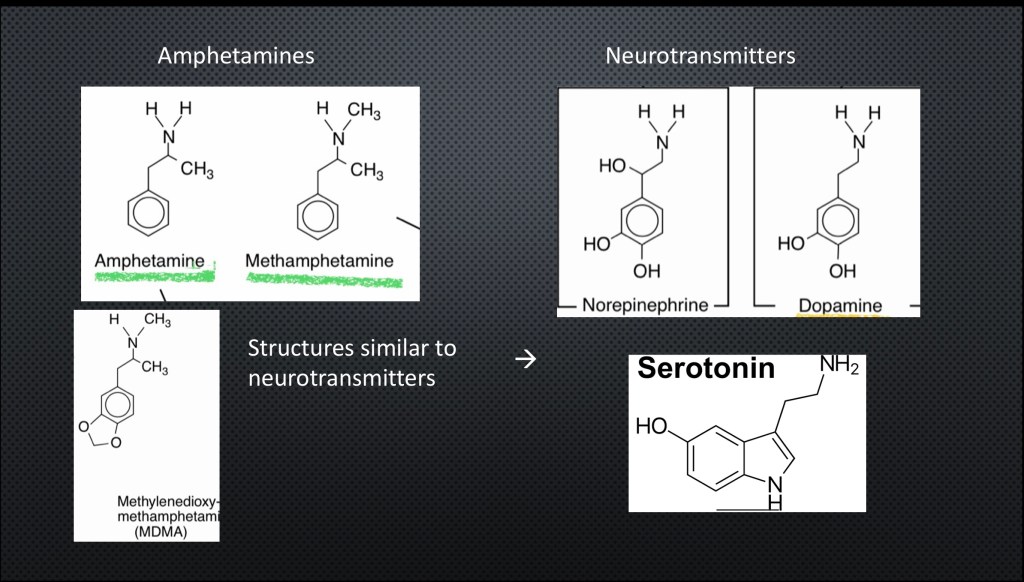
Amphetamines act by increasing levels of three neurotransmitters shown above. These are Dopamine, norepinephrine, and serotonin.
Together these neurotransmitters are referred to as monoamines. They are modified amino acids. They are small molecules synthesized in neurons and other tissues throughout the body. Levels of these are normally tightly regulated and small changes can have significant consequences.
Note the similar chemical structures. This structural similarity is the key to how amphetamines work. Amphetamines can directly act on the same receptors and transporters as existing neurotransmitters. In effect they act in place of the naturally occurring transmitters.
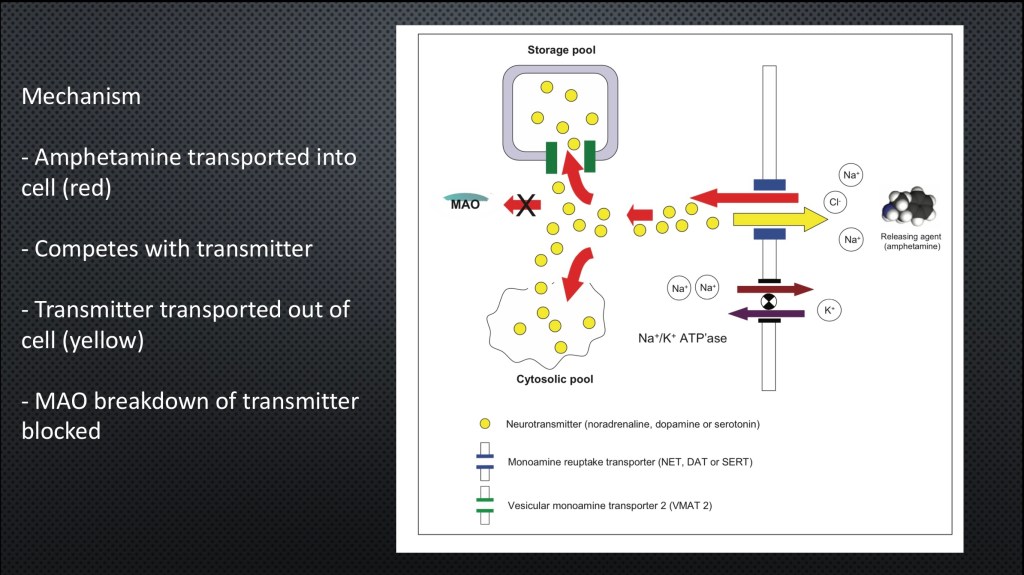
This diagram shows how amphetamines work in the cell.
The red arrows represent amphetamine moving into the cell.
Yellow indicates naturally occurring neurotransmitter (DA, Ser, Ne)
The process occurs in five steps resulting in bursts of neurotransmitter release.
- Amphetamine from the bloodstream is taken up by the cell
- Once inside it competes with existing pooled cellular neuro transmitter
- Neurotransmitter is released, “pushed” out by influx of amphetamine
- Sodium/potassium ion pumps are activated making the cell more reactive.
- Normal breakdown of neurotransmitter by MAO is inhibited further increasing levels
This is a powerful direct driving mechanism. Most drugs act indirectly resulting in lower extracellular levels of neurotransmitter.
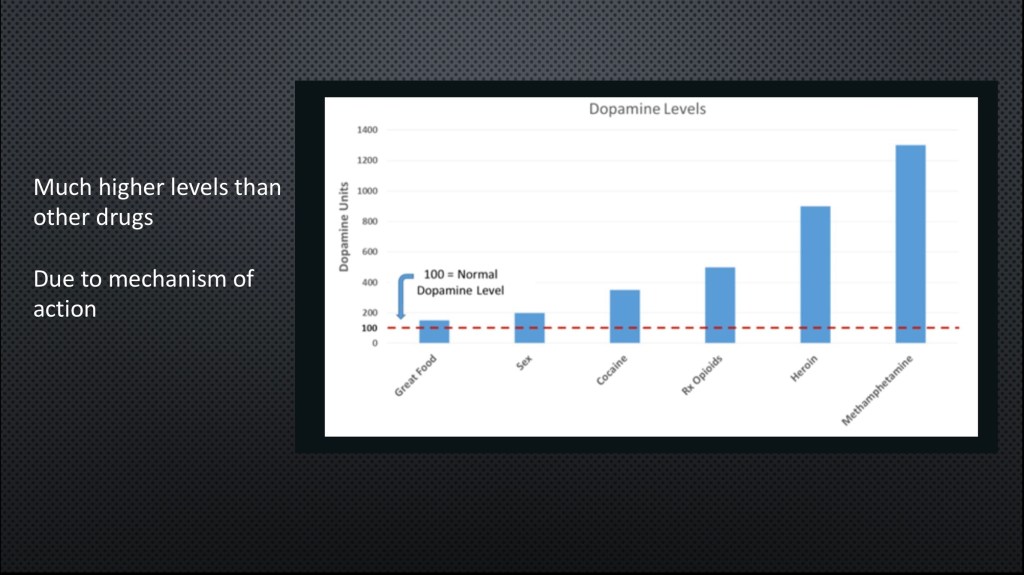
Dopamine levels are increased by rewarding activities and various drugs. Methamphetamine is represented on the far right with much higher dopamine release than other drugs and activities. High neurotransmitter levels are responsible for a number of actions in the brain and other organ systems. The effects depend on the specific drug and dose level. This accounts for some of the highly addictive and neurotoxic effects of these drugs.

This diagram represents the three types of cells affected by amphetamines dopamine, norepinephrine, and serotonin.

Amphetamines differ in the levels of each type of neurotransmitter activated. Above graphs represent levels of dopamine and norepinephrine released by the d- and l- forms of amphetamine respectively. MDMA is predominantly a serotonin activator. Methamphetamine strongly activates dopamine and serotonin pathways.

Physical, affective and psychological effects are broad due to the spectrum of neurotransmitter release. Both euphoric and dysphoric effects can be experienced. Preference and subjective effects can differ between individuals. This suggests a genetic component mediating individual drug response.
Dopamine, serotonin, and norepinephrine pathways are shown above. These overlap in distribution and function. Imbalance and dysfunction in one system affects the others. Over time epigenetic and neuroplastic changes occur resulting in long term effects.

Amphetamines have widespread systemic effects. The monoamines affected also act as systemic hormones. Amphetamines result in activation of the hypothalamic pituitary axis and directly on major organ systems. Systemic effects include hypertension, increased heart and respiratory rate, elevated core body temperature, insomnia, and nausea at higher doses.
Overdose or chronic use may result in cardiovascular events including stroke, arrhythmia, or myocardial infarction. Seizures or psychosis may occur. Elevated body temperature can result in muscle breakdown leading to kidney failure.
There is no specific antidote available. Emergency treatment is supportive and individual symptoms are managed as needed. Benzodiazepines are often used to control seizures and neurological complications. Control of body temperature, blood pressure, respiratory and cardiac support are managed as indicated.

Brown Trout in Czechoslovakia have been affected. Not making this up.
This post focused on basic pharmacology, mechanism of action, and physical effects of amphetamines and related drugs. The following post will focus more on non medical use of methamphetamine, addiction, treatment, and related pathology.
References to be included in a subsequent post.
…………………………………………………………………………..
Thank you for your consideration in reviewing this post. Comments and suggestions are welcome.
For education and information purposes only. No commercial or institutional interest. This post should not be considered medical or professional advice. Images and data obtained from sources freely available on the World Wide Web.
 Sober Synthesis
Leave a comment