
The Endocannabinoid System
Discovery & Component Structures

The recent discovery of a widely distributed cellular signaling system present in the brain and in organ systems throughout the body represents a scientific milestone. Much of how it works and what it may mean in potential therapeutic benefits remains a mystery at this point.
This post focuses on the endogenous cannabinoid system. The story of its discovery, and an introduction to its principal components.

Raphael Mechoulam was born in Sophia, Bulgaria in 1930. Fleeing Nazi persecution of Jews his family relocated for a time to a small village in the Balkans. His father was eventually sent to a concentration camp which he survived. In 1949 the family relocated to Israel.
Raphael continued his studies in Haifa, Israel eventually earning a PhD in biochemistry. He was appointed professor at Hebrew University in Jerusalem where he was to spend the rest of his career. Dr. Mechoulam passed away in March, 2023.
Dr. Mechoulam was interested in active plant compounds and began to isolate compounds found in hashish. In 1963 he isolated cannabadiol (CBD) and in 1964 tetrahydrocannabinol (THC). These discoveries greatly accelerated research throughout the world into the biological activity of substances present in the cannabis plant.
While various labs were able to synthesize and test these and synthetic similar chemicals, for the next 25 years nobody really knew how they worked. Because they are lipoids (fatty molecules) it was thought that they simply directly diffused through lipid cell membranes and then acted within the cell.

William DeVane was a graduate student working on his PhD in the lab of Dr. Allyn Howett at St. Louis University in the late 1980s. At that time the pharmaceutical company Pfizer had developed synthetic THC like compounds and sent them to the lab for further investigation. DeVane took on the project as his doctoral thesis.
In a series of experiments using radioactive labels they were able to conclusively demonstrate the presence of an active cannabinoid receptor binding both natural and synthetic THC in brain cell membranes. The publication of this landmark paper in 1988 demonstrating a heretofore unknown biological system resulted in a host of new research efforts. Soon after this discovery a second receptor was found. These are now known as CB1 and CB2. The receptor DNA was subsequently sequenced and cloned by Lisa Matsuda at the NIH in Maryland in 1990.
Receptors had been found but what functions did they perform ? DeVane continued the investigation joining Dr. Mechoulam’s lab in Jerusalem. In 1992 they isolated the first known Endocannabinoid, a substance produced by humans and other animals binding to cannabinoid receptors. They called it Anandamide after the Sanskrit word for bliss.
Following his post doctoral work DeVane returned to the US and continued to work on the function of anandamide at the NIH. He passed away in October 2018.
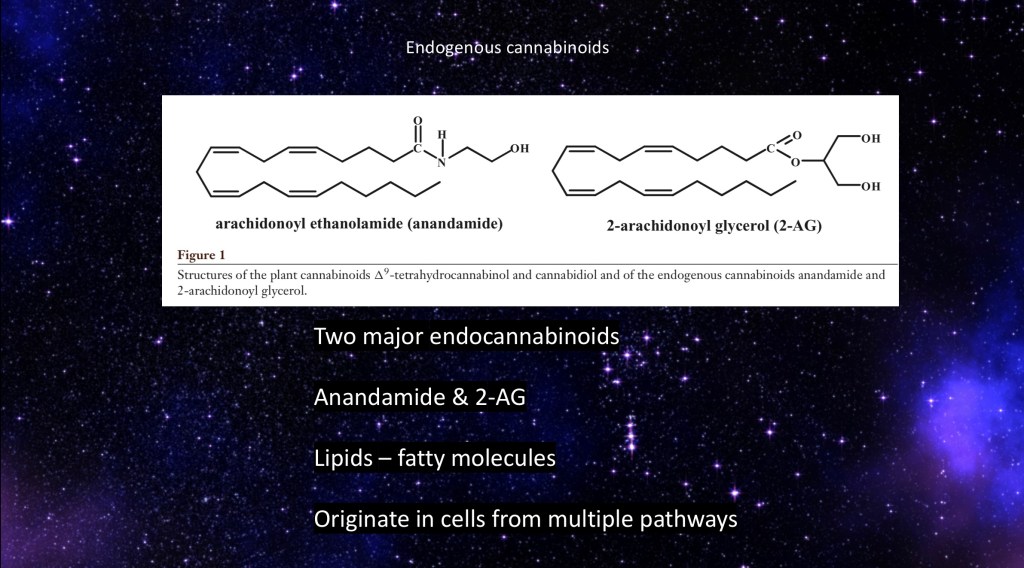
There are two known Endocannabinoids, Anandamide and 2-AG. They are very similar in structure differing by a few bonds at the polar ends. Both of these have a fatty acid type structure. In this respect and others endocannabinoids are very different from neurotransmitters such as dopamine. They are not stored in vesicles but rather the precursors are present in cell membranes with the final product directly released into the extracellular space.
Despite structural similarities the two ECs derive from entirely distinct pathways. They also break down along different pathways within the cell.

There are two major Endocannabinoid receptors. These are referred to as CB1 and CB2. There are many of both types found throughout the brain as well as other body tissues. Outside of the central nervous system they are most concentrated in the gut and immune system. In the brain they are present not only in neurons but in other brain cells such as astrocytes and microglia.
The receptors bridge the cell membrane and multiple receptors may be present on the same cell. The distribution of CB1 and CB2 receptors overlap and both types may be present in the same tissue.
To further add to the complexity of the system anandamide and 2-AG can bind to both types of receptors. Endocannabinoids are modulators, regulators of cell function through inhibition of neurotransmitter release.

This diagram demonstrates a typical CB1 receptor pattern at a cellular junction in the brain. The small green boxes represent receptors. They are present on glutamate (excitatory) neurons and GABA (inhibitory) neurons. The relationship of the Endocannabinoid system as it interacts in the nervous system and other tissues is highly complex and still incompletely understood.
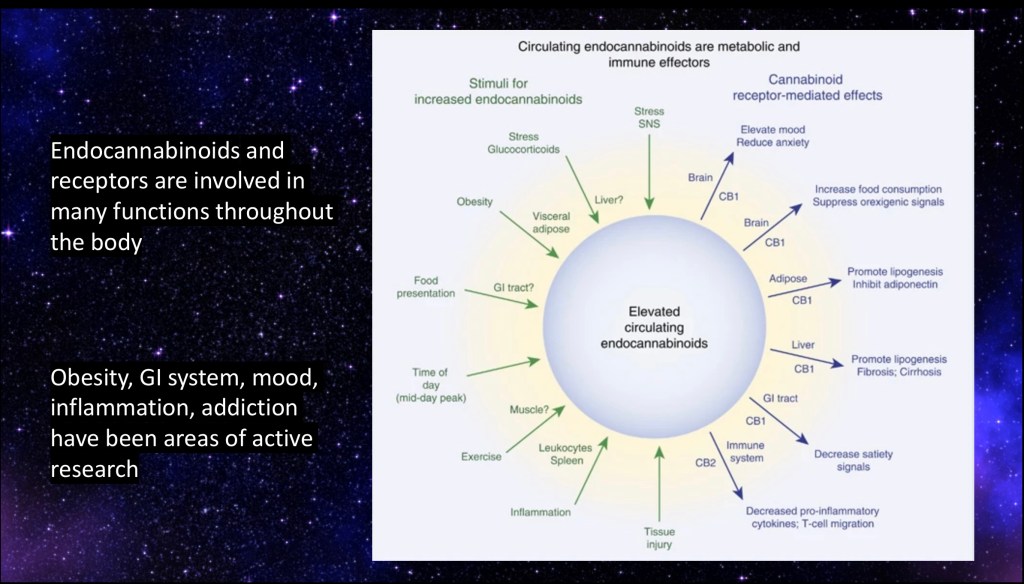
On the left of this diagram are factors which stimulate the Endocannabinoid system. These include stress, food, inflammation, exercise and time of day.
On the right are cannabinoid effects. These include decreased anxiety, elevated mood, increased food intake and decreased inflammatory response.
………………
This post tells the story of the discovery of the Endocannabinoid system and its basic functional components. It is a new frontier with the very real possibility of significant benefits to come. The next post will discuss a more detailed review of what is known about this system particularly as it applies to addiction neuroscience and emerging therapeutic targets.
Thank you for your consideration in reviewing this post. Any comments or feedback are welcome.
For information and educational purposes only. No commercial or institutional interests. Data and images obtained from sources freely available on the World Wide Web. This post should not be considered medical or professional advice.
REFERENCES
………………………………
Pharmacol Rev. 2006 September ; 58(3): 389–462.
The Endocannabinoid System as an Emerging Target of Pharmacotherapy
PÁL PACHER, SÁNDOR BÁTKAI, and GEORGE KUNOS
Laboratory of Physiologic Studies, National Institute on Alcohol Abuse and Alcoholism, National Institutes of Health, Bethesda, Maryland
…………………………………………………
11C-JHU75528: A Radiotracer for PET Imaging of CB1 Cannabinoid Receptors
Andrew G. Horti, Hong Fan, Hiroto Kuwabara, John Hilton, Hayden T. Ravert, Daniel P. Holt, Mohab Alexander, Anil Kumar, Arman Rahmim, Ursula Scheffel, Dean F. Wong and Robert F. Dannals
Journal of Nuclear Medicine October 2006, 47 (10) 1689-1696;
https://jnm.snmjournals.org/content/47/10/1689
………………………………………….
How the Endocannabinoid System was Discovered
WRITTEN BY: Melissa Moore
LabRoots
https://www.labroots.com/trending/cannabis-sciences/8456/endocannabinoid-system-discovered
…………………………………………..
Structure of a cannabinoid receptor and functional expression of the cloned cDNA
- Lisa A. Matsuda, Stephen J. Lolait, Michael J. Brownstein, Alice C. Young & Tom I. Bonner
Nature 346, 561-564 1990
https://www.nature.com/articles/346561a0
……………………………………………….
MEDICAL CANNABIS SATIVA (MARIJUANA OR DRUG TYPE): THE STORY OF DISCOVERY OF Δ9-TETRAHYDROCANNABINOL (THC)
1, * Ravindra B. Malabadi, 2Kiran P. Kolkar, 1Raju K. Chalannavar
International Journal of Innovation Scientific Research and Review
Vol. 05, Issue, 03, pp.4134-4143, March 2023
…………………………………………
The Endocannabinoid System and the Brain
Raphael Mechoulam and Linda A. Parker
1Institute for Drug Research, Hebrew University, Medical Faculty, Jerusalem 91120, Israel; email: mechou@cc.huji.ac.il
…………………………………………….
Determination and Characterization of a Cannabinoid Receptor in Rat Brain
William A Devane et Al.
Molecular Pharmacology 34:605-613
August 30,1988
Devane original article 1988 cannabinoid receptor
……………………………………………………
Neuropsychobiological Evidence for the Functional Presence and Expression of Cannabinoid CB2 Receptors in the Brain
Emmanuel S. Onaivi
Department of Biology, William Paterson University, Wayne, N.J., USA
………………………………………………
Jeff K. 8/2023
 Sober Synthesis
Leave a comment