

Cellular neuroplastic change
Role in addiction

Previous posts discussed alterations in neural circuits occurring as addiction takes its course. In the past addiction was seen as uncontrolled pursuit of pleasure requiring only detoxification followed by the willpower not to repeat the errors of the past.
We now know that addiction is driven by drastic changes in key areas of the brain impairing decision making, motivation, affect, and behavior. We now also know that alterations persist long past the detoxification stage. The focus in research has shifted to the recovery phase.
Memory is not a ghost in the machine. Memory becomes encoded in physical changes at the cellular level. It is not enough to just generally attribute it to genetics, epigenetics, and neuroplastic change. We need to find precisely which genes, epigenetic factors and specific structural neural changes are involved.
Over a century ago a Spanish pathologist, Ramon Santiago Cajal observed that cells were separated by a synapse and these synapses and neural networks changed over time. He postulated that this was the basis of learning and memory. It is only recently that the biological basis of memory and learning is beginning to be discovered.

Eric Kandel was the first to demonstrate the cellular basis of learning and memory. He chose the sea slug for his investigations because of its simple nervous system, large neurons, and limited repertoire of behavior.
The slug has a withdrawal reflex when touched at its siphon. After repeated stimulation the reflex diminishes, a rudimentary form of short term learning. After habituation a small shock produces an exaggerated withdrawal, short term potentiation, requiring only the production of the neurotransmitter serotonin. More shocks result in a longer withdrawal, long term potentiation. This requires DNA activation (epigenetic) and new synaptic growth (neuroplastic). Shortly thereafter details of the biochemical pathways involved in these processes were discovered.
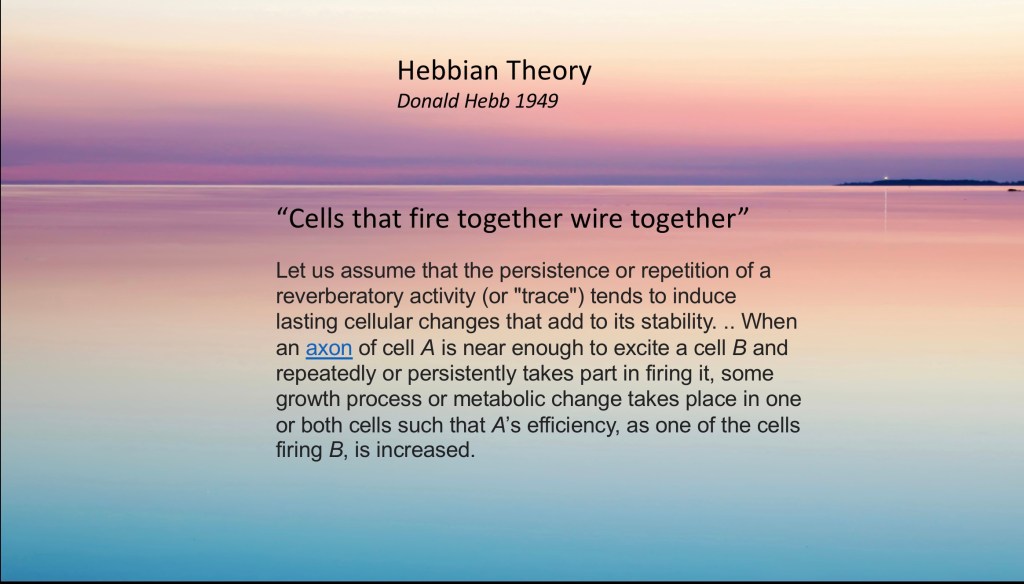
What Kandel did was to verify Hebb’s famous postulate “cells that fire together wire together”.

Repeated stimulation causes a cascade of reactions and new synaptic growth
Once the epigenetic factor is established, even after a long rest, a single stimulus is enough to cause new growth. This is called Long Term Potentiation.
The DNA itself does not change.
In addiction the drug is the stimulus.
Memory is both a conscious and unconscious process involving neural networks, epigenetic, biochemical and neuroplastic changes. These processes play a significant role in addiction.
Addiction is a chronic condition. Craving and recurrence are common occurrences. Even after a long period of abstinence relapse often quickly progresses to an uncontrolled use pattern as if one had never stopped at all.
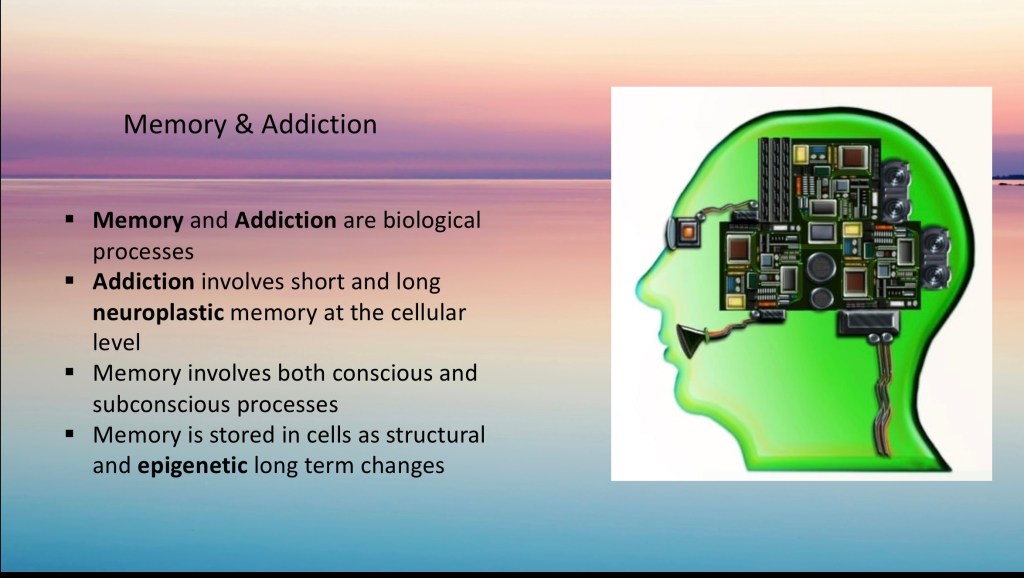
When asked “what does DNA do?” the first thing that comes to mind is heredity and chromosomes neatly lined up in pairs. In cells what it actually does is code for protein synthesis.
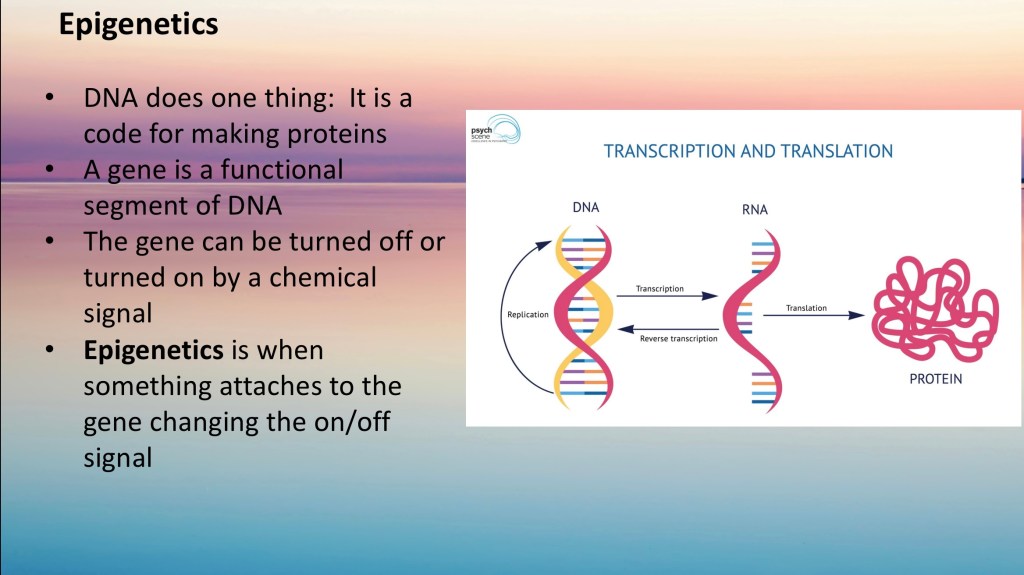
Genes are functional units of DNA. In response to a signal the encoding segment turns on resulting in transcription to messenger RNA which then results in translation in the cell body to protein polypeptides.
Epigenetics refers to a signaling molecule or process triggered by something external resulting in a long lasting change in regulation of genes. Certain drugs or environmental signals can result in an epigenetic change.
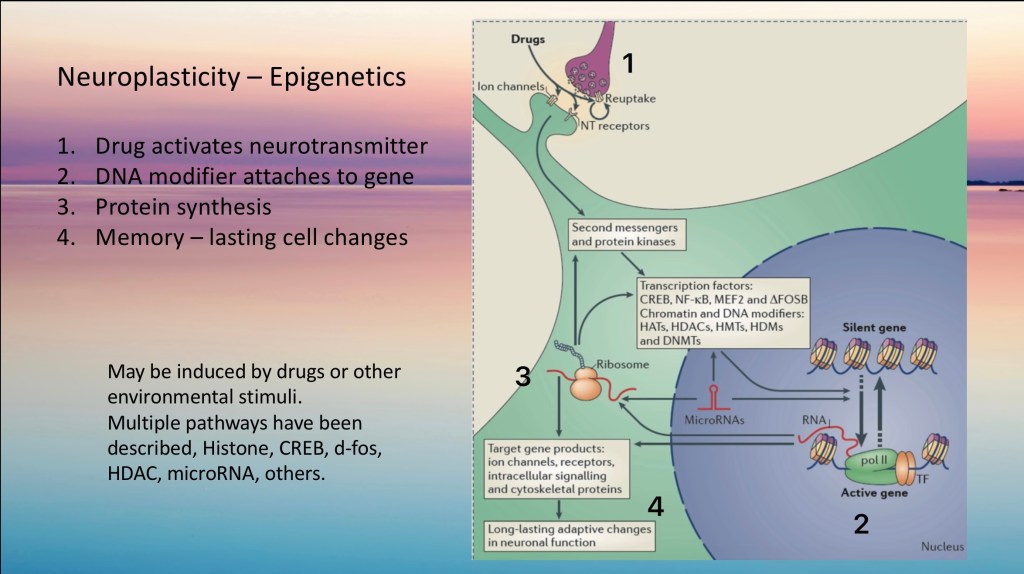
The pathways involved are often complex. The diagram above can be broken down into four basic steps.
- A drug causes neurotransmitter release and activation of a cellular metabolic pathway.
- A transcription factor is activated and acts on DNA.
- mRNA initiates protein synthesis in the cell body.
- Products may result in production of ion channels, receptors, components of growth or other cellular processes resulting in long lasting changes in cell function.
Next let’s take a closer look at more specific changes found in addiction.

Shown is a micrograph of a medium spiny neuron in the nucleus accumbens. These are regulatory cells and play an important role in addiction.
Many dendrites are seen projecting from the cell body. The yellow dots are dendritic spines. These are where synaptic connections occur. An increase in dendrites and dendritic spines will increase the number of synapses formed.
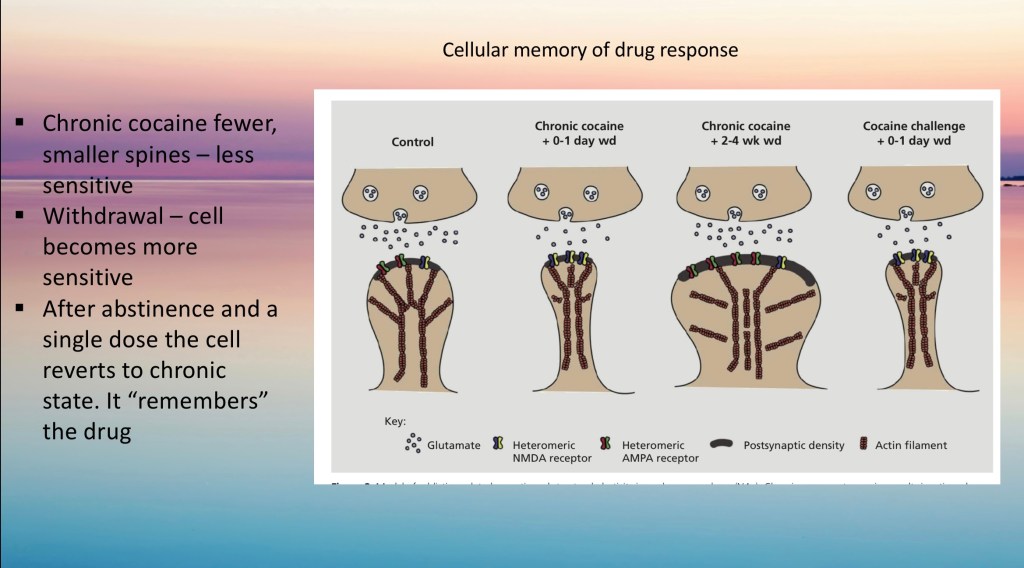
Neuroplasticity in cocaine response.
Here we see changes in dendritic spines in response to cocaine exposure. From left to right.
- Control without cocaine exposure. The neurotransmitter here is glutamate.
- Spine after chronic cocaine. It is smaller in size and the type of receptors has changed to NMDA.
- Spine after a 2-4 week withdrawal. The spine is increased in size and receptor type is now mostly AMPA. These changes will affect how the cell responds to glutamate signals.
- Following withdrawal a single dose of cocaine is given. The cell “remembers” cocaine and quickly reverts back into the chronic cocaine configuration.

Multiple second messengers, DNA modifiers, and pathways have been identified. One of the most studied with key roles in neuroplastic long term changes in addiction is the delta-FosB protein.
d-FosB is one of a family of cell proteins. Levels of d-FosB in response to addictive drugs have been shown to increase with repeat drug doses. It is an essential modifier of long term changes including transmitter receptor type, endorphin production, and increase or decrease in dendrites and dendritic spines.
The table above summarizes d-FosB regulated neuroplasticity in chronic cocaine use.


Addictive drugs result in changes in cell structure modulated by a variety of mediators and pathways. The tables above summarize various effects from stimulants and opiates.

Morphine and other opiates result in long term changes in dopamine neurons. This diagram demonstrates cell structure and function in chronic opiate use.
- The cells decrease in size
- Fewer potassium channels result in depressed cellular responsiveness
- Fewer neurotransmitter receptors. Decrease in regulation from GABA signals
- Results in decreased dopamine production. This results in less reward signal accounting for part of drug tolerance. Increased drug dose and frequency of use to maintain steady state and avoid withdrawal effects.
- These effects may persist for some time in abstinence
- Beneficial neuroplastic changes occur in recovery. The following are examples of beneficial neuroplastic changes.
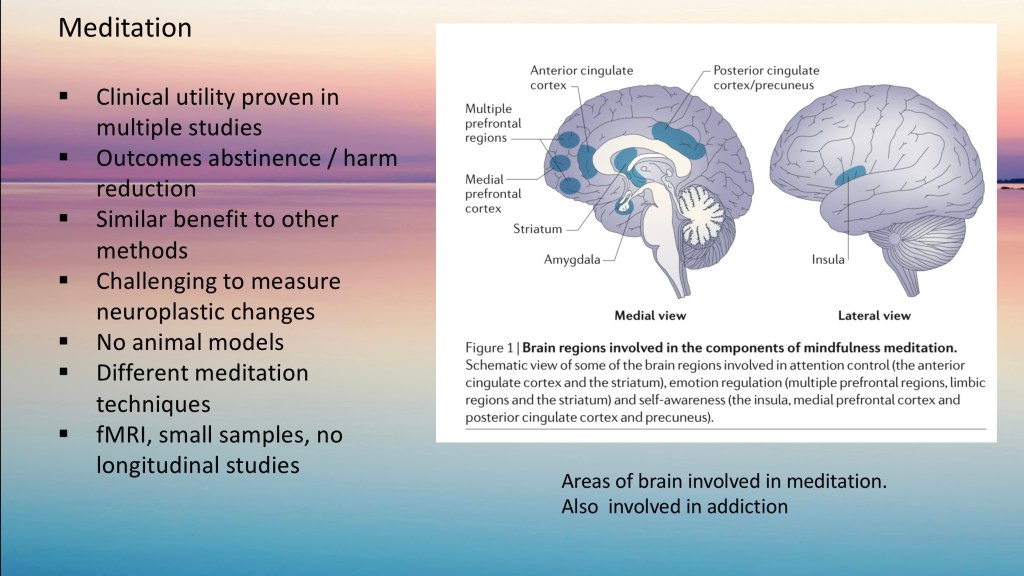
Meditation techniques are practiced by some individuals as a part of a recovery program. This shows areas of the brain known to be involved in meditation practices. Many of these areas are also involved in addiction.
Identification of specific cellular changes in meditation is difficult for several reasons. Animal studies are lacking as lab mice simply will not engage in meditation. Much of what we do know about cellular memory comes from animal studies. In humans epigenetic and long term neuroplastic changes can be inferred through observational studies.
Electrophysiologic recording and fMRI can be done in humans but yield limited information about cellular function.

Clinical studies have established therapeutic efficacy of meditation as part of treatment for SUD. This study followed 286 subjects for one year. They were randomly divided into three groups:
1) usual counseling treatment
2) relapse prevention treatment
3) mindfulness relapse prevention therapy
At 12 months the third group had significantly better outcomes compared with the other two approaches. 92% reporting no heavy drinking in 12 months compared to 81% for the standard treatment group. Overall the mindfulness group reported better outcomes on all measured categories.
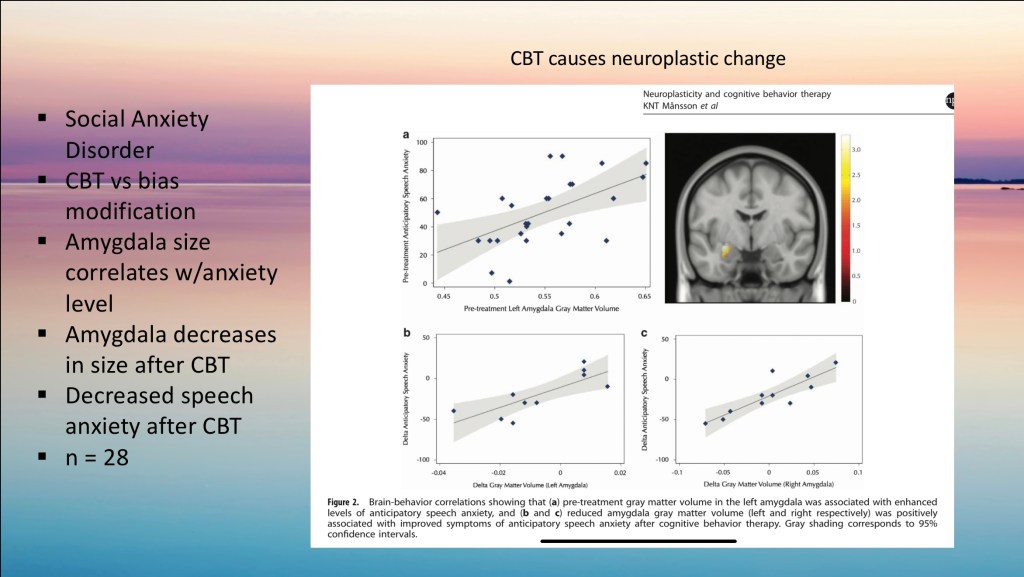
Cognitive Behavioral Therapy has been studied. There is some experimental evidence of neuroplastic change along with clinical outcomes.
This study looked at subjects with social anxiety disorder. CBT was compared with bias modification treatment. Post treatment change in anticipatory speech anxiety was measured as an outcome. The amygdala is known to be a modulator of anxiety. Volume of the amygdala was measured by MRI. Activation of the amygdala measured by fMRI was also assessed and compared between the two groups.
The top graph above shows that increased anxiety corresponds to increased size of the amygdala. The lower graphs of right and left sides demonstrate that decreased size corresponds to decrease in anxiety following CBT treatment.

From the same study. Top graph shows that the amygdala became smaller following CBT but remained unchanged or larger following modification therapy.
The lower graph shows that there was lower activation following CBT compared to the modification group.

Clinical efficacy of CBT in treatment of substance use has been shown in multiple studies. This study in 48 subjects compared a computerized CBT program with usual counseling treatment. Reported results were verified with urine testing.
The CBT group reported more days abstinent and longer continuous abstinent days in comparison to the controls.
Cellular learning and memory is an integral part of the neurobiology of addiction which continues into recovery and abstinence. Neuro plastic and epigenetic changes contribute to pathologic processes as well as therapeutic approaches promoting restoration of health and healing.
As new therapeutic options emerge along with evidence based treatments learning and memory at the cellular and functional level must be taken into account. New discoveries hold the promise of improved treatment options for substance use disorders.

REFERENCES
Sensitization memory
MECHANISMS OF ACTION OF ADDICTIVE STIMULI Incentive-sensitization and addiction
TERRY E. ROBINSON & KENT C. BERRIDGE
……………………………………..
The incentive sensitization theory of addiction: some current issues
Terry E. Robinson* and Kent C. Berridge
………………………………………..
https://ajp.psychiatryonline.org/doi/pdf/10.1176/appi.ajp.162.8.1414
Learning and memory
………………………………………….
Cellular basis of memory for addiction
Pages 431-443 | Published online: 01 Apr 2022
https://www.tandfonline.com/doi/full/10.31887/DCNS.2013.15.4/enestler
………………………………………………..
Neuron, Vol. 25, 515–532, March, 2000, Copyright 2000 by Cell Press
Addiction, Dopamine, and the Review Molecular Mechanisms of Memory
Joshua D. Berke*§ and Steven E. Hyman*†‡
……………………………………………..
Neural bases of learning and memory: functional neuroimaging evidence
Roberto Cabezaa and Lars Nybergb
……………………………………………
The Neural Basis of Involuntary Episodic Memories
Shana A. Hall1, David C. Rubin1,2, Amanda Miles2, Simon W. Davis3, Erik A. Wing1, Roberto Cabeza1, and Dorthe Berntsen
……………………………………..
https://www.sciencedirect.com/topics/psychology/motor-memory
………………………………………
Dopamine release from the locus coeruleus to the
dorsal hippocampus promotes spatial learning
and memory
Kimberly A. Kempadooa,1, Eugene V. Mosharovb,c,d,e, Se Joon Choib,c,d,e, David Sulzerb,c,d,e, and Eric R. Kandel
…………………………………….
https://zuckermaninstitute.columbia.edu/eric-r-kandel-md
……………………………………..
Relapse Induced by Cues Predicting Cocaine Depends on Rapid, Transient Synaptic Potentiation
Cassandra D. Gipson,1,3,* Yonatan M. Kupchik,1,3 Haowei Shen,2,3 Kathryn J. Reissner,1 Charles A. Thomas,1
Neuron 77, 867–872, March 6, 2013 a2013 Elsevier Inc.
…………………………………………..
The molecular biology of memory: cAMP, PKA, CRE, CREB-1, CREB-2, and CPEB
- Eric R Kandel
Molecular brain 5, Article number: 14 (2012)
https://molecularbrain.biomedcentral.com/articles/10.1186/1756-6606-5-14
……………………………………………..
Transcriptional and Epigenetic Mechanisms of Addiction
Alfred J. Robison and Eric J. Nestler
Fishberg Department of Neuroscience and Friedman Brain Institute, Mount Sinai School of Medicine, One Gustave L. Levy Place, Box 1065, New York, New York 10029
Nat Rev Neurosci. ; 12(11): 623–637. doi:10.1038/nrn3111.
…………………………………………….
The Addicted Synapse: Mechanisms of Synaptic and Structural Plasticity in Nucleus Accumbens
Scott J. Russo1,*, David M. Dietz1, Dani Dumitriu1, Robert C. Malenka2, and Eric J. Nestler1
Trends Neurosci. 2010 June ; 33(6): 267–276. doi:10.1016/j.tins.2010.02.002.
https://www.ncbi.nlm.nih.gov/pmc/articles/PMC2891948/pdf/nihms181669.pd
………………………………………………………
The neuroscience of mindfulness meditation
Yi-Yuan Tang1,2*, Britta K. Hölzel3,4* and Michael I. Posner2
Nature Reviews Neuroscience | AOP, published online 18 March 2015; doi:10.1038/nrn3916
……………………………………………
Månsson, K., Salami, A., Frick, A. et al. Neuroplasticity in response to cognitive behavior therapy for social anxiety disorder. Transl Psychiatry 6, e727 (2016). https://doi.org/10.1038/tp.2015.218
https://www.nature.com/articles/tp2015218#article-info
…………………………………………….
May 2014
Relative Efficacy of Mindfulness-Based Relapse Prevention, Standard Relapse Prevention, and Treatment as Usual for Substance Use Disorders
A Randomized Clinical Trial
Sarah Bowen, PhD1; Katie Witkiewitz, PhD2; Seema L. Clifasefi, PhD1; et al
JAMA Psychiatry. 2014;71(5):547-556. doi:10.1001/jamapsychiatry.2013.4546
https://jamanetwork.com/journals/jamapsychiatry/fullarticle/1839290
………………………………………………
Mindfulness-Based Relapse Prevention for Alcohol and Substance Use Disorders
Katie Witkiewitz, PhD
University of Illinois, Chicago
G. Alan Marlatt, PhD Denise Walker, PhD
University of Washington, Seattle, WA
Journal of Cognitive Psychotherapy: An International Quarterly
Volume 19, Number 3 • 2005
…………………………………………..
Neurosci Biobehav Rev. 2013 November ; 37(0): . doi:10.1016/j.neubiorev.2013.03.019.
The clinical relevance of neuroplasticity in corticostriatal networks during operant learning
Matthew E. Andrzejewski1, Brenda L. McKee2, Anne E. Baldwin3, Lindsay Burns4, and Pepe Hernandez4
1University of Wisconsin-Whitewater, Whitewater, WI 2Edgewood College, Madison, WI
3State University of New York at Geneseo, Geneseo, NY
………………………..
The psychological science of addiction
Elizabeth Gifford & Keith Humphreys
Veterans Affairs and Stanford University Medical Centers, Palo Alto, CA, USA
…………………………………..
A longitudinal study of the comparative efficacy of Women for Sobriety, LifeRing, SMART Recovery, and 12-step groups for those with AUD
https://www.sciencedirect.com/science/article/pii/S0740547217304907
……………………………………
Computer-Assisted Delivery of Cognitive-Behavioral Therapy for Addiction: A Randomized Trial of CBT4CBT
Kathleen M. Carroll, Ph.D. et al
(Am J Psychiatry 2008; 165:881–888)
https://ajp.psychiatryonline.org/doi/pdf/10.1176/appi.ajp.2008.07111835
……………………………………..
AMAZING PAPERS IN NEUROSCIENCE
Discovering Memory: Using Sea Slugs to Teach Learning and Memory
Devon C. Riegel
School of Psychology and Neuroscience, University of St. Andrews, St. Andrews, UK
The Journal of Undergraduate Neuroscience Education (JUNE), Fall 2020, 19(1):R19-R22
………………………………….
For educational and information purposes only. No commercial or institutional interests. This post should not be considered medical or professional advice. Data and images obtained from sources freely available on the World Wide Web.
Thank you for your consideration n reviewing this post. Any feedback or suggestions are welcome.
 Sober Synthesis
Leave a comment